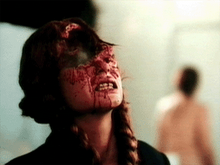
The Omen was one of those glossy, big-budget horror films, with Hollywood money and distribution, big-name stars, and a veneer of mainstream respectability, but it also had a darkly wicked sense of humor, mercilessly savage death scenes, great atmosphere, and a top-notch Jerry Goldsmith score. For Hollywood horror, it's pretty damn solid. It was a huge hit, and plans were quickly put into place by
Omen producer Harvey Bernhard to churn out a couple more sequels, though only composer Goldsmith and actor Leo McKern (in a brief role) return from the first film.

Damien, like most sequels, can't match the impact of the original, and director Don Taylor is a less accomplished visual stylist than the first film's director, Richard Donner (who was too busy filming Superman to take on this one), but the sequel has a lot going for it, including a better overall pace (the first film drags a bit in the return-to-Rome stretch in the middle), a couple of over-the-top nutso death scenes, and a pretty good cast. Taylor, a character actor and journeyman filmmaker who also directed Escape from the Planet of the Apes (the third film in the series), the '70s adaptations of Tom Sawyer and The Island of Dr. Moreau, and a whole bunch of episodic television, was hired after Damien had already begun filming, replacing Mike Hodges (also the co-screenwriter), who was fired a few weeks into the shoot.

It's fascinating to think about what the sequel could have been under Hodges' direction. He wanted to focus on the monstrous power corporations were increasingly having over politics and everyday life while tying it into the resurgence of apocalyptic religious hysteria, and he liked to spend a long time planning and setting up shots, angering the producers, who felt he was breaking the schedule and the budget and deemphasizing the horror movie thrills. Taylor, on the other hand, had a reputation for staying on schedule, coming in under budget, and doing what the studios wanted. Hodges, who also directed the original Get Carter, The Terminal Man, Flash Gordon (replacing a fired Nicolas Roeg), Black Rainbow, and Croupier, would have made a much more stylish film, but I also like the visceral, nuts-and-bolts Taylor approach, and he manages to capture the occasional beautiful shot, like the ice skaters in the snow from above (unless that one was left over from the few weeks of Hodges).
Though this film was released two years after the first
Omen,
Damien takes place seven years later. Our Antichrist demon-child is now approaching thirteen and has been adopted by his Chicago-based uncle and step-aunt after the deaths of his parents in the first film, played by Gregory Peck and Lee Remick. The adoptive parents are played by another famous woman named Lee, Lee Grant, and the original choice for the Gregory Peck role, William Holden. Holden summarily dismissed the first
Omen offer by saying he didn't want to be in a devil movie. After seeing how much money that film and its second-choice star Peck made, Holden changed his tune and decided that he very much wanted to be in a devil movie. Even so, it's not one of my favorite Holden performances. He does a competent job, but you can tell he's not feeling this one the way he's feeling
The Wild Bunch or
Network. Grant, on the other hand, seems to be enjoying herself, and her character has a bit more to work with than Remick had.

Our new tween Damien (Jonathan Scott-Taylor) has an inexplicable British accent. Yes, Damien and his parents lived in England in the first film, but they were Americans (Peck played the newly appointed American ambassador to the UK), and he moved back to the States when he was still a small child after their deaths. Why the accent, guv'nor? Cor blimey! (I apologize to any and all UK readers.) The answer to this not-really-a-mystery is that Scott-Taylor is British. He was the actor the producers liked best, he looks a lot like the actor from the first movie, and he can do the Satanic stare almost as well as the little scamp from Omen number one, so let him have his British accent, is what I assume happened.

Damien has bounced from one exceedingly comfortable home, the child of a powerful political appointee, to another. His uncle Richard (Holden) is an executive at a multi-national corporation whose headquarters are in Chicago. Another exec, Paul (Robert Foxworth), has a gross but popular plan to control the world's food supply, with the only thing standing in his way the moral opposition of the company's aging CEO, Bill Atherton (Lew Ayres), playing perhaps the most farfetched character in film, the corporate CEO with ethics and a conscience.
Paul takes an unholy interest in Damien, as does the newest administrator, Sgt. Neff (Lance Henriksen), at the elite military academy for rich legacy kids that Damien and his cousin/brother Mark (Lucas Donat) attend. Damien, who'd mostly forgotten about being the Antichrist and was enjoying regular pre-teen life (or at least as regular as a spoiled rich kid at an elite military school who has weird occult powers sometimes can enjoy), relearns his Satanic purpose from Neff and Paul and begins to unleash hell, just in time for puberty. Unfortunately, Henriksen's role was scaled back by Taylor. Hodges was going to do a lot more with him.
You know what you're going to get if you've seen the first film. Someone learns that Damien is the Antichrist, tries to stop the Devil's plan or warn someone who can help, and gets crushed, devil-style. There are two surprisingly uninteresting death scenes in this film, but they are balanced out by two of the craziest, including a fantastic elevator scene. There's not much powerful opposition, narratively. Fighting the devil is a bit like the Mulkey Brothers trying to fight the Road Warriors. You will get the holy living fuck beat out of you, and it's not even close.
What can I say? This is a solid sequel. Not great, not terrible, legitimately entertaining, with a couple of thrilling moments. I didn't even mention the supporting roles for Allan Arbus, Sylvia Sidney, and, in his film debut, Meshach Taylor, as well as some fine work from some creepy crows, wrangled by the same animal trainer who handled the birds in
The Birds. Is
Damien: Omen II necessary? No, but what is? If you had a good time with the first one, you'll probably have a good time with this one.