Disconnected is a deeply eccentric slice of regional underground horror, made in Waterbury, Connecticut, by DIY filmmaker Gorman Bechard and a cast and crew of mostly local talent. It starts out as an offbeat hangout movie, turns into a slasher and a suspense thriller, and finally morphs into a semi-abstract arty depiction of a mental breakdown or torment by a malevolent entity (or both). Not everything is successful and a few scenes have poorly recorded sound, but it's got personality, atmosphere, humor, creepiness, power-pop jams, some striking shot compositions, and lots of local color, and it's probably the only film where someone is murdered to XTC's "Complicated Game."
The film opens with video store clerk and classic Hollywood film buff Alicia (Frances Raines, the great-step-niece of Claude Rains, who gets name-checked, and, yes, that's how they spell their names) arriving at the two-story home where she rents the top floor. A weird old man (William A. Roberts) is trying to get in. Alicia assumes the old man is looking for her twin sister Barbara Ann (also played by Raines) because a lot of men in town are looking for Barbara Ann, and she lets him inside. He does something weird to her telephone and disappears. Say what?
The strangeness of this scene and everyone's behavior in it aside, I really dig how Alicia decorates her top-floor pad (though the credit belongs to director Bechard, who was actually living there at the time). There are classic Hollywood posters everywhere (her top faves are Marilyn, Bogart, and Hitchcock), an antique clock, a hi-fi stereo (Talking Heads'
Speaking in Tongues at the front of the record pile), and all kinds of early 20th century kitsch, much of it also connected to movie people (lots of Groucho stuff), and the place gets excellent natural window lighting. I get a sweetly painful melancholic feeling thinking about the various pop-cult-decorated living spaces of friends and acquaintances in my pre-21st-century-tech/phone/social media college-town days, so when a movie really nails the look of one of those spots, it punches me right in the heart.
The movie quickly jumps from this oddball opening sequence to a hopping bar scene. Alicia, her boyfriend Mike (Carl Koch), Barbara Ann, and Barbara Ann's date for the night are catching up over drinks, though Alicia is a bit on edge because she suspects that Mike and Barbara Ann are having an affair. It's frustratingly hard to make out the dialogue in the noisy, crowded bar in this scene (the sound improves in most of the subsequent scenes), but my frustration turned to delight when the camera swept down the length of the bar, capturing little moments from the other patrons including a guy using magic tricks to impress the woman sitting next to him (she seemed to be into it), and when the scene shifted to the dance floor. Our characters and several extras start busting moves as only 1984 Caucasian Connecticut new-wavers can to the new-wavy power-pop jams of local band The Excerpts, playing a live gig in the bar.
Time for a digression about an Excerpts band member. Making his onscreen debut in
Disconnected, 19-year-old Excerpts singer/guitarist Jon Brion would go on to incredible success in the years ahead. After the dissolution of his post-Excerpts power-pop band The Bats (not to be confused with the excellent New Zealand band The Bats), Brion moved to Boston, met Aimee Mann (they were a couple for several years), and became touring guitarist for 'Til Tuesday in that band's final years. Brion then moved to Los Angeles, founded short-lived band The Grays with ex-members of Jellyfish, became a go-to session musician and arranger for dozens of disparate artists, produced albums for Aimee Mann, Fiona Apple, Rufus Wainwright, Robyn Hitchcock, Of Montreal, Frank Ocean, Janelle Monáe, Katy Perry, Mac Miller, Sky Ferreira, Best Coast, and pre-insanity Kanye West, had a wildly popular years-long weekly residency at Largo, and enjoyed a parallel career as a film composer. He was Paul Thomas Anderson's go-to composer prior to Jonny Greenwood, co-composing the score to
Hard Eight with his ex-girlfriend Mann's husband Michael Penn, playing on Penn's
Boogie Nights score and appearing in a small role, composing the scores for
Magnolia and
Punch-Drunk Love, and contributing a few leftover pieces from these earlier scores to
One Battle After Another. His other film composing credits include
Eternal Sunshine of the Spotless Mind,
I Heart Huckabees,
Synecdoche, New York,
Step Brothers,
Lady Bird, and
Pee-wee As Himself (with Penn). Digression complete.

Dance party concluded, Alicia gets into an argument with Mike in the car, where his denials about sleeping with Barbara Ann don't seem that believable. Alicia heads home, where she hears weird distorted sounds on her phone and a conversation between Mike and Barbara Ann about their affair. Is she imagining this? What is up with her phone? Meanwhile, young women are being raped, murdered, and mutilated all over the city. A fifth victim has been found, exasperating Hawaiian-shirt-wearing, hoagie-eating (or, in Waterbury parlance, grinder-eating) homicide detective Tremaglio (Carmine Capobianco), who can't catch a grinder break. His partner slaps him on the back when he's on the roof of a parking garage, causing him to drop his grinder on the street below. Later, on stakeout and eating a grinder in the car, his partner admonishes him for sitting on his ass and eating too many grinders, reminds him that the murdered women can never eat a grinder again, and tells him to leave his half-eaten grinder in the car despite Tremaglio's complaints that it will get cold. The man just wants to eat a hot grinder in peace while he brainstorms how to catch the killer.
At work the next day in her small, strip-mall video store, Alicia is admonished by a customer named Joey (the hilariously monikered Professor Morono, who plays a character named Joey the Creep in Bechard's subsequent feature
Psychos in Love), who demands to know the names of the newest porn rentals and whether they're any good. When Alicia says she doesn't watch porn, Joey is flabbergasted, yells "fuck this shit!," and hits the road.

Just as flabbergasted by Joey's behavior is the only other man in the store, Franklin (Mark Walker). Franklin is a polite, soft-spoken, friendly, but deeply strange young man who has a crush on Alicia after seeing her in the bar. He complains about the lack of foreign and classic films in the store to Alicia's agreement, remarks on how many new movies they have, and says he doesn't own a VHS or Betamax machine but that he would rent movies here if he had one. He then asks her out. Alicia says she'd like to but has a boyfriend. Franklin takes this rejection well, offers to bring her lunch and a soda, and leaves his number in case she changes her mind. He then exits with his signature farewell catchphrase, repeated multiple times throughout the movie and filling me with joy and delight each time. When Franklin bids you adieu, he says, in his particular soft-spoken style, "okay, see ya bye" with the "see ya" and the "bye" pronounced so closely to each other that they sound like a single word ("seeyabye"). This never stops being funny, and I want to say it to everyone when I exit the premises.
Alicia eventually makes up her mind that Mike and her sister have been getting their bone on, so she calls Franklin to take him up on his offer of a date. Franklin is happy to hear from her, but is soft-spoken seeyabye Franklin also our killer? Oh shiiiit! Is this seeyabye forever for Alicia?
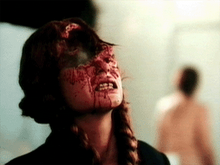
Events proceed in this direction until everything is cleanly but semi-tragically wrapped up by the film's halfway point. WTF? Or is it? Much of the rest of the film takes place in Alicia's top-floor pad, where she drinks her sorrows away in her underwear and is constantly tormented by her phone. Her mental state fractures and the film's style becomes claustrophobic and abstract, leading to a truly strange and baffling ending that I'll be chewing on for a while. The sound design becomes very important here, with the ringing of the phone, the ticking of the clock, and the bizarro demonic noises coming from the receiver amplified on the soundtrack. This is a wild swerve in direction from Bechard, and, while it's not as much fun as the film's first half and can even drag in places, it's a pretty daring move. I had to admire it.
Flawed as it is,
Disconnected is an original and subversive twist on the slasher film, and the actors all have a refreshing non-Hollywood personality, delivery, and eccentricity. Raines gives both sisters completely different attitudes and physical presences, Walker makes Franklin such a fascinatingly kooky dude, and Capobianco really sells his grinder exasperation. We've all been there, even though I call them hoagies (and used to call them submarine sandwiches in my youth). I love the local Waterbury detail (the rental house, the video store, the bar/rock club, the neighborhoods, the city streets and buildings), and I like how Bechard gets so many memorable images on such a tiny budget. (I talked about the rest of Bechard's career and how he moved from low-budget horror movies to indie dramas to documentaries, including several docs about musicians, animal rescues, and pizza-making, in my post about
Cemetery High a few years ago.) I really liked this movie, mostly. Okay, seeyabye.




No comments:
Post a Comment