
I'm facing some possible desperate living of my own as I write this post, as yet another potentially disruptive winter storm descends upon Texas, a state with its own unreliable power grid (because of liberty, you see?), except for the wise people of certain parts of west Texas, who are hooked to the national grid. Will I finish my post today or at some unspecified future date when power is restored (if the power goes out)? My wife and I lost power for seven days in 2023 and lost running water for three days in 2021, so we're both slightly on edge but reasonably prepared.

You know who wasn't reasonably prepared? The Good Housekeeping film critic, who walked out of the Desperate Living premiere after ten minutes, a badge of honor I'm sure John Waters wears proudly. Desperate Living, the only Waters film of Divine's lifetime without Divine (he reluctantly withdrew from the production due to a clash in schedules with the off-Broadway play Women Behind Bars) (the same goes for David Lochary, whose drug habit kept him from appearing in this one and who would die from drug-related injuries shortly after Desperate Living's release), is a hilariously mean-spirited, vulgar, transgressive, disgusting, and heartwarming tale of the power of women to overcome a fascist queen of a godforsaken burg called Mortville near Baltimore. We could all learn a lot from this one. (My non-storm thoughts today are with the good people of Minneapolis fighting the fascist federal government of our nationwide Mortville.)

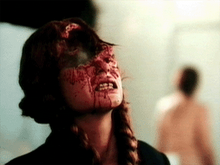
Though I'm a fan of Desperate Living as a whole, I think the opening scene is one of the greatest pieces of comedy ever filmed and Mink Stole's tour-de-force. (Her "I hate the Supreme Court" line has become the most inevitable 2020s online meme.) I could watch two straight hours of Mink Stole yelling at people over the phone, and I'd be in heaven. Cranking Sirkian melodrama and those very special TV movies about suburban women having nervous breakdowns up to eleven (after a very Douglas Sirk opening credit sequence, except for the cooked rat on the dinner tray, of course), the opening scene begins with boys playing baseball in the yard of a suburban Baltimore home. A doctor exiting the home tells the family patriarch Bosley Gravel (George Stover) that his wife is the most neurotic woman he's ever met and that she should return to the institution. Bosley calmly tells the doc everything's hunky dory and that she's improving. In her upstairs bedroom, Peggy Gravel (Mink Stole), proceeds to unload on everything and everyone around her at fever pitch, especially when the boys' errant baseball smashes through her window. It's truly one of the greatest things I've ever seen. Stole yells classic line after classic line in her wonderfully inimitable style ("Go home to your mother! Doesn't she ever watch you? Tell her this isn't some Communist day care center! Tell your mother I hate her! Tell your mother I hate you!"). It could go on forever and I would be a pig in mud.

Through an escalating series of events, Peggy and her maid Grizelda Brown (Jean Hill) kill Bosley and go on the run. Once on the open road, Grizelda lets Peggy know the power balance has shifted: "I ain't your maid anymore, bitch. I'm your sister in crime." (John Waters should be on the Mount Rushmore of movie dialogue writers, if one were ever to exist. What a weird fucking project that would be.) The women stop to camp despite Peggy's hatred of nature ("Look at those disgusting trees, stealing my oxygen! Don't we taxpayers have a voice anymore?"). Unfortunately, a Baltimore motorcycle cop (played by the wonderfully named Turkey Joe in his only film role) pulls in and threatens to arrest them. (There's already an APB out for them even though the killing happened minutes ago.) The cop lets them go and gives them directions to Mortville in exchange for their underwear and a couple wet kisses. A fair deal. Who is Turkey Joe and why is this his only film role? I need to know more about Turkey Joe. He also delivers a tour-de-force here, half of it while simultaneously wearing three pairs of women's underwear.

Mortville is a shanty town with no indoor plumbing (except at the bar) on the outskirts of Baltimore populated by society's outcasts. Its fascist monarchy is run with an iron fist and many whims by Queen Carlotta (the one and only Edith Massey) from her castle. She's guarded by a group of men in Gestapo-meets-leather daddy regalia, and her castle is adorned with painted portraits of Idi Amin, Hitler, and Charles Manson. Her rebellious adult daughter Princess Coo-Coo (Mary Vivian Pearce) is kept under close supervision in her bedroom, and Carlotta disapproves of Coo-Coo's relationship with nudist garbageman Herbert (George Figgs).

Peggy and Grizelda rent a newly available spare shack from the power couple of disgraced former professional wrestler Mole McHenry (Susan Lowe), on the run after killing Big Jimmy Dong in the ring, and Marilyn lookalike Muffy St. Jacques (Liz Renay) (check out Renay's life story to take a wild ride), who suffocated her child's terrible babysitter in a bowl of dog food. Divine was originally going to play Mole, which would have been an interesting departure. Mole is a very butch masculine character, and Divine usually played such fabulously over-the-top women for Waters. I'm a little bummed we'll never see Divine's take, though Lowe is an excellent member of the Waters troupe in her own right and does a fine job here. (My favorite Lowe performance is Vikki, the salon receptionist in Waters' masterpiece Female Trouble: "Boys, she won't pay. Take the hairdo back!")

Tensions between the Mortville residents and Queen Carlotta reach a boiling point, the resolution of which involves collapsing homes, rabies potions, betrayal, gunplay, deaths, nudity, a botched sex change operation, armed revolt, a fantastic-looking Cookie Mueller, and the immortal line, "Get out of my chambers, lesbians!" It's the quality entertainment some of us deserve.

Divine is missed, but Desperate Living is otherwise top-shelf Waters. It's his ugliest, grimiest, and nastiest movie and plenty disgusting (though nothing reaches the gag-reflex high/low of Divine eating the dog shit in Pink Flamingos), and it's also one of his funniest and most life-affirming. Mink Stole and Edith Massey are so goddamn hilarious here, and, though Waters may vomit at what I'm about to type, the movie is an earnest tribute to the power of collective action over I-got-mine-so-fuck-you individuality. There's a utopian aspect to Waters' films that makes a lot more sense to me than the kumbaya hippy shit utopias we usually get in artistic works. His characters just want to live life on their own terms (as the filthiest people alive, or in specific cha-cha heels, or as a serial killer of disrespectful fellow suburbanites) without a boot on their necks, and they succeed when they team up to defeat the squares, winning or losing on their own terms without relinquishing their individual personalities or watering down their unsavory qualities. I love these characters so much.

Watching a John Waters '70s movie in the 2020s gives me melancholic, bittersweet feelings about the robustness of the various countercultures in the 20th century. In our current social media/content creator world, we have the worst of both monoculture and underground culture without the benefits of either. Almost everything shares a similar flattened aesthetic form and delivery system, but we're all consuming it separately in isolation, except for the occasional viral moment. Younger artists are too often worried about offending people or being observed and recorded or making a public mistake or being misunderstood to create the kind of joyfully transgressive work that Waters made.




No comments:
Post a Comment