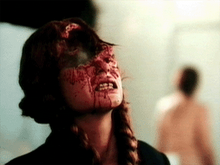
Demon Wind is a low-budget horror movie that borrows heavily from
The Evil Dead and
Night of the Living Dead, but anyone expecting the same-old same-old from that description should raise their expectations. Maybe not in terms of quality (the movie is extremely stupid in a myriad of hilarious ways), but in terms of subverting the dominant paradigms of logical character behavior and narrative coherence,
Demon Wind will surprise you at least three times no matter how many cheap horror flicks you've seen (and no matter how many times you've already seen
Demon Wind). Writer/director Charles Philip Moore balances every well-worn horror cliché with at least two moments of unexpected lunacy or confusion-inducing nonsense, and I thank him for it.

Beginning with some historical demonic possession and exploding farmhouse biz in 1931, Demon Wind soon jumps to the present with our stubbornly driven young hero Cory (Eric Larson) and his momentarily exasperated but generally supportive girlfriend Elaine (Francine Lapensée) driving to the location of the old exploded farmhouse for reasons known only to Cory. Cory recently discovered his father was orphaned in the 1931 farmhouse disaster and only survived because he was in an incubator in the hospital at the time, though Cory also says his father was born in 1929 in a later scene. One of those dates has to be incorrect or the father was either a two-year-old in an incubator or mysteriously born twice; either explanation is perfect Demon Wind logic. Whatever the year of his birth, Cory's father, after years of normalcy, begins acting strangely, moves to a shack in the California countryside near the farmhouse, and cuts off ties to his family. When Cory drops in on his father to get an explanation, the old man tells him a crazy story about demons killing the biological grandparents he'd never known and then 23 skidoos this mortal coil by slashing his wrists with a razor.

Cory does what any logical person would do after these events. He keeps it all to himself but takes his girlfriend to the cursed exploded farmhouse's location and invites his entire group of friends out there, too, telling them he needs them. Why does he need them? Emotional support? Because each of them possesses a special skill? No, man, it's so most of them can be killed by demons. For our enjoyment.

The friend group covers the key demographics of horror movie friend groups from the home video era. We have the already mentioned Cory, the insanely driven go-getter protagonist with a family secret; Elaine, the supportive girlfriend, sexy blonde version; Dell (Bobby Johnston), a sexist and homophobic jock asshole who's quick to anger and ready to fight and who would never hang out with these people in real life but is somehow an integral member of every teen/twentysomething friend group in every movie made between 1979 and 1993; Terri (Lynn Clark), the supportive girlfriend, brunette version, who is inexplicably partnered up with Dell despite her friendliness and even-keeled demeanor; Jack (Mark David Fritsche), the intellectual guy with glasses (who is a dead ringer for Tears for Fears' Curt Smith and shares his '80s hairdo); Bonnie (Sherry Leigh), Jack's girlfriend and the skeptical member of the supportive girlfriend triptych (she also fulfills the 1984-1990 requirement that at least one member of the group has to be wearing pink); and, last but not least, the most common friend group stereotype of them all, Chuck (Stephen Quadros), a magician who is also really good at karate. I'm so sick of seeing the karate-magician in every damn movie. Who's with me? Chuck is accompanied by his hype man Stacy (Jack Forcinito), who seems to be secretly in love with Chuck, though Chuck is only in love with magic and adventure, which is why his previous relationship with Terri fell apart.
Dell, already hotheaded, is not too happy to see his lady's ex, especially after Chuck karate-kicks a beer can at Dell's head after Dell tries to punch him. Chuck then pulls out a white handkerchief, says "Shazam," turns the handkerchief into a dove, and throws the dove into the air. The dove promptly shits on Dell. Dell's beautiful response, "You son-of-a-bitchin' idiot!" Did I forget anyone? Yes, and the movie almost forgot them, too. Willy (Richard Gabai) and Reena (Mia M. Ruiz), an alternative hipster couple, arrive fashionably late and are almost immediately killed by demons. Is that a spoiler? You can't spoil
Demon Wind, son. Miss me with that question and go back to demon wind school.

The friends initially meet up at the only café/gas station (and the only sign of life) for miles, run by a surly old man who warns them away from the old farmhouse site and waves a gun in their faces and an oddball waitress/clerk who keeps asking them about a woman none of them know named Little Linda. Classic Demon Wind. The café menu doesn't look too bad and is pretty varied (and cheap!) for such a remote location. You can get ribs, a half-chicken, giant burgers, and fish and chips for a buck or two, though I'd stay away from the fish burger. The drink options? Coke, beer, water, or goat's milk. You know some joker, probably named Tiny or Red or Big Al, is going there every week for a fish burger and goat's milk. Classic Tiny.

Our legendary group, despite the warnings and Bonnie's bad vibes, carries on with the pilgrimage and arrives at the farmhouse remains. All that's left is a few burnt farmhouse walls and the front door, an abandoned barn, a skeleton on a cross, and a partially buried skull poking out of the grass. You'd think someone would have cleaned that shit up between 1929/1931 and 1990, but they were all too busy knocking back fish burgers. Things get even spookier when they walk into the door. The house reappears intact around them. This freaks them out enough to make them leave, but the batteries in all their cars are dead. They decide to hoof it back to civilization, but an eerie fog accompanied by some wind .. some DEMON wind ... passes through, changing the landscape behind them to different isolated forest scenes before depositing them right back at the farmhouse.

Soon, the group is beset by Evil Dead-style demons, and they respond by boarding up the windows and doors Night of the Living Dead-style. The demons start moving and attacking like Romero zombies. I have to hand it to these demons. They adapt quite well to the style of whichever movie is being ripped off. We also get a spell book, magic daggers, X-Men-style superhero mutations, people getting turned into dolls, adults turning into children turning into doves (if you get access to a dove for one scene, you might as well put it in two scenes), a failed seduction by a sexy topless demon played by porn star and Gorgeous Lady of Wrestling Tiffany Million, karate-kick beheadings, psychedelic cartoon FX, and a huge monster demon played by someone named C.D.J. Koko in his only film role.

Demon Wind is a silly movie, full of nonsense, but it's just the kind of nonsense that warms my heart. I had a good time watching this thing several years ago, and I had a good time watching it last night. A straight-to-video movie that only got a theatrical release in Germany, Demon Wind was mostly forgotten until its appearance on the first season of The Last Drive-In put it in the cult movie canon. I bet it plays great with an appreciative late-night crowd. It also teaches us some important lessons. If you need to go to a possessed farmhouse to fight demons, invite an egghead with glasses who looks like one-half of an iconic '80s synth-pop duo, an asshole meathead, a martial artist/magician, their supportive girlfriends and/or hype men, and a couple hipsters. They won't be any help to you, but the demons will be so distracted killing them that you and your girlfriend will have time to figure out a plan and, when everything is said and done, you can make some new friends that are less annoying.

Writer/director Charles Philip Moore hasn't been active in film since the '90s, but he worked as a screenwriter, actor, and assistant director on several late '80s and '90s b-movies, and his other directing credits include Dance with Death, about a reporter going undercover as a stripper to catch a serial killer, Blackbelt, about a martial arts expert and former cop protecting a rock star from a serial killer while also fighting off other martial arts experts, and Angel of Destruction, which has the exact same plot as Blackbelt, except that the ex-cop is still a cop and is a woman instead of a man.
Notable cast members include Bobby Johnston, who, in addition to his extensive b-movie CV, is a model and former Playgirl centerfold; Lynn Clark, who played the longest-lasting Jerry Seinfeld girlfriend on Season 1 of
Seinfeld (she appeared on two episodes and was mentioned as Jerry's girlfriend on two other episodes before finally being dumped and was involved in George's first Art Vandelay namedrop); Sherry Leigh, a stuntwoman who hails from my home state of Nebraska; Richard Gabai, b-movie actor and director whose filmmaking credits include
Assault of the Party Nerds,
Virgin High,
Assault of the Party Nerds 2: The Heavy Petting Detective,
Vice Girls,
Kickboxing Academy,
Motocross Kids, the Lifetime movies
Expecting Amish and
Mommy, I Didn't Do It, and the Hallmark movie
A Gingerbread Romance; and the karate-magician himself, Stephen Quadros, who is a true Renaissance man. He initially moved to Hollywood as a heavy metal drummer, where his band Snow was popular on the club scene. Snow fell apart when guitarist Carlos Cavazo quit to replace Randy Rhoads in Quiet Riot (Rhoads left to join Ozzy's band). Quadros auditioned for KISS but injured his hand shortly thereafter and turned to acting. He's worked steadily as an actor since (mostly in b-movies and episodic TV) while also putting his mixed-martial arts background to use as a sports journalist (where he earned the nickname The Fight Professor), MMA play-by-play commentator, and fight coordinator/choreographer in the television and film industry. He appeared as himself in
The Smashing Machine. I'll always think of him as Chuck.
"You son-of-a-bitchin' idiot!"