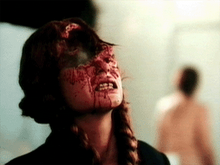
Despite a troubled production that saw most of the cast and crew clash with director Rupert Julian and a finished product that is pieced together from different cuts and directors, The Phantom of the Opera is a silent horror classic that feels cohesive and focused. The chaos behind the scenes doesn't appear onscreen. Chances are, even if you haven't seen The Phantom of the Opera, you're familiar with Lon Chaney's phantom makeup and the look of the film from all its appearances in pop culture in the ensuing century. I still prefer this movie to the many other film adaptations that followed.
For the few of you unfamiliar with the story, the film opens with two men purchasing the Paris Opera House from the old owner. After the sale has been notarized, he lets them know the place is haunted by a cloaked phantom (Lon Chaney). The men are charmed by the legend of the ghost until they experience him in action. The mysterious figure, living deep in the catacombs below the opera house, takes a tremendous liking to Faust understudy Christine (Mary Philbin) and demands via a series of mysterious letters that she take over the lead or terrible things will happen. They don't listen. Terrible things happen. Then our story really cranks up.
The Phantom of the Opera is a film that succeeds because of a talented cast, innovative set design, and a strong story. This is not a film where a visionary director is calling the shots. Julian (and uncredited directors Chaney and Edward Sedgwick and Ernst Laemmle) isn't a poet of images like contemporaries F.W. Murnau, Fritz Lang, Robert Wiene, etc., and is instead an employee of a Hollywood studio doing a professional job of work.
Or maybe not. Julian is in the history books as the first person from New Zealand to act in, write, produce, and direct feature films, and he enjoyed some success in Hollywood as an actor and director, but he rubbed many people the wrong way on this project. Disliked by most of the cast and crew, Julian had especially strained relations with Chaney, who communicated with Julian only through an intermediary and who directed most of his own scenes. (Ernst Laemmle, nephew of producer and studio executive Carl Laemmle, also directed a few scenes.) There is also a rumor that actor Norman Kerry (who played the Vicomte Raoul de Chagny) hated Julian so much that he charged at him on horseback in front of the crew, knocking him to the ground.
In addition to all this backstage drama, the studio got cold feet after a preview screening of an early cut of the film got poor reviews. Deciding to retool the film from a Gothic dramatic horror to a romantic comedy, they ordered Julian in for re-shoots, but he walked off the project in disgust. His replacement was comedy director Edward Sedgwick, best known today for the excellent Buster Keaton film The Cameraman. Sedgwick added new characters, subplots, and a whole lot of silliness. This version went down like a lead zeppelin with audiences and critics at further preview screenings, who hated the clashing tones and epic length. The studio reconsidered the whole romantic comedy angle and took out most of Sedgwick's scenes, replacing them with Julian's scenes from the first cut. Sedgwick's ending (with the (WARNING: SPOILER AHEAD! OH SHIT!!!!!!) villagers chasing the phantom to his watery grave) and a few comedic scenes with the original characters stayed put, but Julian's material was reincorporated from the original, and the multi-director Frankensteined cut we know and love was the result. This time, the critics were mildly happy, with reservations, while audiences were really happy. The Phantom of the Opera was a box office hit.
Setting aside all the troubled backstage trivia and simply watching it as a movie, I remain impressed by the awe-inspiring studio sets (parts of the opera set still exist today and were refurbished and used by Alfred Hitchcock's crew for 1966's Torn Curtain), the phantom's elaborate underground lair (his bed was later used as Gloria Swanson's in Sunset Boulevard), Lon Chaney (who must have been contractually obligated to star in every American horror movie and thriller in the 1920s) and his self-applied makeup, and the incredible Technicolor masked ball scene, which must have blown people's minds in 1925. (It was only the 38th film to use color in any capacity, and among the first handful to be widely seen by American audiences.) I tend to prefer personal films where a director with an artist's eye and strong personality are guiding the production, but there are plenty of great movies where this isn't the case. The Phantom of the Opera is in that second group.
Saturday, March 12, 2016
Friday, February 26, 2016
#226: Basket Case 2 (Frank Henenlotter, 1990)
Ignoring the real-world eight-year gap between the first Basket Case and its sequel, B-movie legend Frank Henenlotter begins this second installment moments after the first film ended. Fans of Basket Case (that's all of us, right?) who have never explored the sequels may be thinking to themselves, "Didn't our main characters plummet to their deaths at the end?" We all thought so until 1990, but Henenlotter informs us here that they merely plummeted to their extreme inconvenience. Belial is bruised and cut, and Duane (a returning Kevin Van Hentenryck) has head and leg injuries, but our telepathic murderers-with-hearts-of-gold formerly conjoined twin heroes, one of whom is a tiny, misshapen mutant who lives in a wicker basket, are still alive, which is great for almost everyone.
Despite being alive, things are otherwise not looking so great for Duane and Belial. They're slowly recovering from their injuries in a Manhattan hospital, unaware they've become media sensations in the entire state of New York and are wanted for five murders. Meanwhile, in Staten Island, a woman and her granddaughter see a news report about Duane and Belial and quickly drive their van to the hospital in the dead of night to snatch them away. The women, Granny Ruth (jazz singer Annie Ross of Lambert, Hendricks & Ross and Altman's Short Cuts fame) and Susan (Heather Rattray), operate a covert safe space for severely mutated "freaks" in suburban Staten Island, and they provide shelter and a home for Duane and Belial. Granny Ruth is a retired psychologist who was given the pejorative (and lazy) nickname "Dr. Freak" for her tireless championing of this segment of society.
The movie then jumps ahead four years. Duane and Belial are still in hiding in Staten Island and still wanted by the law. Belial is thriving at Granny Ruth's place and even has a girlfriend, but Duane longs for a normal, independent life and plans on moving out, with hopes of taking Susan with him. His plans are thwarted when tabloid reporter Marcie's (Kathryn Meisle) editor at Judge and Jury ("America's bravest newspaper") assigns her a four-part where-are-they-now anniversary piece about Duane and Belial, and she stumbles across their Staten Island hiding place. Granny Ruth won't let this stand, and mayhem ensues. And keeps ensuing.
Writer/director Henenlotter, the lovably creative loon behind such gems as Brain Damage, Frankenhooker, and, duh, Basket Case, creates an unconventional, goofball sequel that wanders off in its own weird direction instead of tiredly rehashing its predecessor. The satisfyingly scuzzy early-'80s 42nd St. grindhouse atmosphere of the first film is sadly replaced by the generically scrubbed anemia of the suburbs, but there is more than enough here to make up for it. Ross has a fantastic time chewing the scenery, the freaks are a comically strange group of endearingly human types with pushed-to-the-limit prosthetic special effect exteriors, Henenlotter's screenplay is his typically odd mix of naive sincerity, cynicism, and freak-out absurdity ("I understand your pain, but ripping the faces off of people may not be in your best interest"), and his direction is full of cute little nods to Freaks, The Maltese Falcon, Blood Simple, and his earlier films. You also get one of the most distinctively hilarious sex scenes in cinema history. Finally, I'd like to toast the actor playing the elderly proprietor of a carnival sideshow for the following line reading upon being offered one hundred dollars: "One hundred smackeroos? One hundred smackeroos! Whooooooooo! One hundred smackereenies!"
Henenlotter concluded the trilogy the following year with Basket Case 3: The Progeny, which I remember enjoying, just not as much as the first two. Maybe a revisit is in order. Slowing down a bit since his '80s and early '90s heyday, Henenlotter's recent films have included Bad Biology, the story of a woman with seven clitorises falling in love with a man whose mutated penis has a mind of its own, Chasing Banksy, a comedy about the New York art world, and two documentaries, That's Sexploitation and Herschell Gordon Lewis: The Godfather of Gore. I have not seen these films. Anybody have any opinions on them?
I do have opinions on all the other Henenlotter films, and those opinions can be summed up in this single opinion: These movies are awesome. Please see them.
Subscribe to:
Posts (Atom)