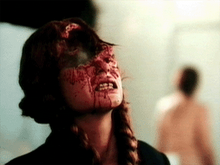
British director John Hough has had a long and varied career, beginning in the 1960s with several episodes of The Avengers and encompassing horror classic The Legend of Hell House, Peter Fonda car chase movie Dirty Mary Crazy Larry, WWII action film Brass Target, live-action supernatural Disney movies Escape to Witch Mountain, Return from Witch Mountain, and The Watcher in the Woods, one of the sequels to A Man Called Horse, Howling IV, Incubus, and the curiously titled Biggles: Adventures in Time. As proof of how weird a journeyman director's career can be, just look at Hough's last two films. 1998's Something to Believe In is one of those cheesy romantic dramas about a terminally ill woman finding one last shot at love, while 2002's Bad Karma is a horror film about a mental patient who wants to kill her psychiatrist because she thinks he is the reincarnation of Jack the Ripper.
I begin this review with a description of Hough's career to illustrate the extreme highs and lows in the filmography of a director-for-hire. And American Gothic is definitely a low. While not without entertainment value, American Gothic is proof that the same guy can make one of the great horror films (Hell House) and one of the least essential. American Gothic has a terrible script that reads like an outline, pedestrian visuals, odd pacing, wooden performances (even from the Hollywood pros), and unlikable jerks for characters, and it fails to create much suspense or dread. Its worth to the modern viewer is primarily its generic ordinariness. It's a genre template in an almost pure state, a historical artifact of late-1980s inessentiality.
American Gothic uses the three primary 1970s and '80s non-supernatural horror conventions: the trip to a remote area gone bad, the classic slasher film setup of a group of young people getting picked off one by one until only one strong yet fragile woman is left, and the family of crazed killers. American Gothic begins with a sexist movie trope that was all too common until recently, namely, that women are more mentally fragile than men when a tragedy or traumatic event occurs, and the tragic event makes them hysterical and places them on a fragile line between sanity and insanity. In this case, Cynthia (Sarah Torgov, in her last film role before quitting the business) and her shitty husband Jeff (Mark Erickson) have lost their baby to a drowning accident in the bathtub. Cynthia is getting out of a Seattle institution after getting the all-clear from her psychiatrist. To celebrate, Jeff takes Cynthia and a group of their shitty, ridiculous friends on a camping trip to one of the Pacific Northwest islands on his small, private plane. En route, the plane has a mechanical failure and starts belching out black smoke, so Jeff lands it on a tiny, remote island and attempts to fix the problem. He can't figure out what's wrong with his plane, so the group of shitty friends set up camp for the night.
In a classic illustration of how generic this movie is, one of the group turns a portable radio to an instrumental song that consists of the same generic guitar riff played over the same generic late-'80s overproduced drum beat looped continuously. After he turns this song on, he says, "Alright! Music!" and starts dancing. Hilarious. Another interchangeable member of this collection of assholes has one of the great '80s mullets. It is the film's most impressive special effect. When one of the women in the group asks Mullet Man if he wants to go scuba diving with her, he replies, "I only go diving for muff." This is the classic dialogue we're working with here.
The next morning, the friends decide to search the island for any signs of life. They tell one of the gang to stay back and guard the plane, for no discernible reason. Eventually, the friends find a house and walk inside after no one responds to their knocking. Time has stopped in the home. There is no electricity and nothing made after the 1920s. Since these people are jerks, they immediately start ransacking the closet, putting on the old clothes and dancing mockingly to the phonograph playing big band music. Minutes later, the home's occupants show up and are not too happy to see a bunch of dicks wearing their stuff. It's an old couple, who refer to themselves exclusively as Ma (Yvonne De Carlo, Ms. Lily Munster herself) and Pa (Rod Steiger). Ma puts on a polite face, but Pa gives them the death stare. It's a look that works on two levels. On one level, the character is expressing his dissatisfaction with the intrusive strangers. On another level, Rod Steiger is expressing the following sentiment: "What the fuck am I doing here? I was in On the Waterfront."
After some halfhearted apologies, the gang gets the go-ahead to shack up at Ma and Pa's place while they wait for a fisherman to arrive the next day, in hopes that he can get the word out about their plane. They aren't going to get any help in that capacity from Ma and Pa. "Do you have a phone or any gas?" Jeff asks Pa. "I don't believe in those contraptions," Pa says. Ah yes, the contraption of gas. That's some contraption. Despite having all kinds of camping gear, the gang decides to spend the night with the creepy religious fanatics who live in a permanent 1920 and don't seem to care for them, although who could blame Ma and Pa? These people are colossal dicks.
Eventually, Ma and Pa's children come home, too. These people are all middle-aged but live in a permanent state of childhood. They're crazier than a shithouse rat, to use one of my grandfather's favorite phrases. We have Woody (veteran character actor Michael J. Pollard), Fanny (Janet Wright), and Teddy (the late William Hootkins, star of killer robot movie Death Machine). It soon becomes clear that this family is not going to let our shitty heroes leave the island, and soon these wicked modern folk get picked off, one by one, until only Cynthia is left.
It's at this point that the film takes a slightly stranger turn, and Rod Steiger gets to have one of the hammy freakouts he was fond of in the second half of his career. There's a solid renunciation of God and a switch of allegiances to Satan, lots of dead bodies, some cookie eating, some use of the contraption of gas, and a missing plane that never does turn up again. This movie is terrible, but I was entertained, as I am by almost every horror film. If you are the kind of person who prefers to dip a toe into the genre on rare occasions, this film is entirely skippable. It's a can-miss 90 minutes of unremarkable entertainment! Oh yeah!
Saturday, August 30, 2014
Saturday, August 16, 2014
#188: The Cabinet of Dr. Caligari (Robert Wiene, 1920)
Two men, one older and one younger, sit in an ominous, almost oppressive darkness, talking. A woman who appears to be in a trance walks past. "That's my fiancée," the younger man says and tells the older man his story. In the story, the man and his friend are both in love with the same woman. They agree to respect her choice and will remain friends no matter what happens. A traveling carnival comes to town, and they attend the festivities together. A creepy older man named Caligari invites them, and several other carnival-goers, into his tent. Caligari brings out Cesare, a somnambulist who has been in a hypnotized sleep state for all of his 23 years. Caligari says he can bring Cesare out of this state briefly in order to predict future events and invites the crowd to ask questions. The zombie-like Cesare stares intensely into the void, and the man's friend asks how long he has left to live. (Bad idea.) Cesare tells him he has only until the break of dawn. The stabbing deaths of the man's friend and a surly clerk follow, and suspicion soon points toward the mysterious Caligari and Cesare.
Of course, if you've seen The Cabinet of Dr. Caligari, one of the most famous horror films, silent films, and German Expressionist works of art, you know how the story shakes down, and you also know how inadequate words and plot descriptions are when considering the visual experience this film provides. Caligari's an important one. Horror wasn't a major genre in the early days of film. Westerns, melodramas, comedies, and little slices of life were the rage in the first 25 years of the medium's existence, with horror playing the part of neglected stepchild. (I do need to point out that there are many exceptions to my generalizations here. Notably, Germany made many horror films in this era. Also, most silent films didn't survive, so their history and our understanding of it will always be incomplete.)
With Caligari leading the charge, however, the 1920s proved to be a landmark decade for horror and silent film in general, with filmmakers mastering the expressive capabilities of the medium before the advent of sound at decade's end forced many to scale back visual expressiveness in order to accommodate the clunky early sound equipment. Several silent horror films predating Caligari have survived, but Caligari is the first one that feels like a fully realized manifestation of the genre.
Director Robert Wiene creates a unified mood, tone, and look that is its own world, a world of shadows, darkness, madness, dread, fear, disorientation, obsession, and murder. Though nearing its centennial, the film feels modern, like someone from the present using an antique medium to burrow into his/her subsconscious. Caligari is still scary and disturbing, with legendary actor Conrad Veidt especially expressive and frightening as Cesare, the somnambulist.
A few words about Veidt. A central figure in silent German horror, Veidt created iconic characters in Caligari, Waxworks, and The Man Who Laughs, with his performance in the latter inspiring the look of the Joker in the Batman comic books. Though he wasn't Jewish, Veidt was married to a Jewish woman and always wrote Jew as his ethnicity on Nazi-mandated paperwork in solidarity with his wife. A staunch and active anti-Nazi, Veidt learned of a plan to assassinate him. The couple fled Germany in 1933 and became British citizens, with Veidt donating most of his money to the war effort. He became a popular character actor in Hollywood, most famously appearing in Casablanca, and he died on a Hollywood golf course of a heart attack at the age of 50 in 1943. I need to quote two sentences from his imdb biography here: "Conrad liked animals, theater, cinema, fast cars, pastries, thunderstorms, gardening, swimming and golfing. He disliked heights, flying, the number 17, wearing ties, pudding and interviews." Veidt also narrowly missed playing Dracula in the famous Universal film of 1931, when he was still living in Germany. Studio head Carl Laemmle wanted Veidt in the part, and it seemed like a good fit, especially considering that German filmmaker Paul Leni, who had worked with Veidt often, was hired as director. As so often happens in Hollywood, time went by and the project moved to different people. When Tod Browning inherited the film, he had his heart set on Bela Lugosi, which turned out to be a pretty great idea. Still, a Veidt Dracula is one of those what-ifs that could have altered the course of horror.
Back to Caligari. Its Expressionist sets have been written about in great detail, so forgive my brief comments here. The deliberate artificiality, distorted perspective, and sharp angles of the backdrops reflect the characters' discombobulated mental states and have the paradoxical effect of making the film feel more plausible emotionally, as well as ensuring a timeless quality that keeps it from being a museum piece. Though the sets are just paint on paper, they create a hypnotic, dreamlike atmosphere and represent much of what draws me to horror as a genre. Even this early in the medium's history, horror was pushing film forward by expanding the limits of visual expressiveness and narrative convention. There is a freedom to experiment without alienating an audience in horror that is not often granted in other genres. The Cabinet of Dr. Caligari is one of those trailblazers, and the film hasn't lost its power. If you haven't seen it yet, what are you waiting for, you knucklehead? (Sorry I called you a knucklehead.)
Of course, if you've seen The Cabinet of Dr. Caligari, one of the most famous horror films, silent films, and German Expressionist works of art, you know how the story shakes down, and you also know how inadequate words and plot descriptions are when considering the visual experience this film provides. Caligari's an important one. Horror wasn't a major genre in the early days of film. Westerns, melodramas, comedies, and little slices of life were the rage in the first 25 years of the medium's existence, with horror playing the part of neglected stepchild. (I do need to point out that there are many exceptions to my generalizations here. Notably, Germany made many horror films in this era. Also, most silent films didn't survive, so their history and our understanding of it will always be incomplete.)
With Caligari leading the charge, however, the 1920s proved to be a landmark decade for horror and silent film in general, with filmmakers mastering the expressive capabilities of the medium before the advent of sound at decade's end forced many to scale back visual expressiveness in order to accommodate the clunky early sound equipment. Several silent horror films predating Caligari have survived, but Caligari is the first one that feels like a fully realized manifestation of the genre.
Director Robert Wiene creates a unified mood, tone, and look that is its own world, a world of shadows, darkness, madness, dread, fear, disorientation, obsession, and murder. Though nearing its centennial, the film feels modern, like someone from the present using an antique medium to burrow into his/her subsconscious. Caligari is still scary and disturbing, with legendary actor Conrad Veidt especially expressive and frightening as Cesare, the somnambulist.
A few words about Veidt. A central figure in silent German horror, Veidt created iconic characters in Caligari, Waxworks, and The Man Who Laughs, with his performance in the latter inspiring the look of the Joker in the Batman comic books. Though he wasn't Jewish, Veidt was married to a Jewish woman and always wrote Jew as his ethnicity on Nazi-mandated paperwork in solidarity with his wife. A staunch and active anti-Nazi, Veidt learned of a plan to assassinate him. The couple fled Germany in 1933 and became British citizens, with Veidt donating most of his money to the war effort. He became a popular character actor in Hollywood, most famously appearing in Casablanca, and he died on a Hollywood golf course of a heart attack at the age of 50 in 1943. I need to quote two sentences from his imdb biography here: "Conrad liked animals, theater, cinema, fast cars, pastries, thunderstorms, gardening, swimming and golfing. He disliked heights, flying, the number 17, wearing ties, pudding and interviews." Veidt also narrowly missed playing Dracula in the famous Universal film of 1931, when he was still living in Germany. Studio head Carl Laemmle wanted Veidt in the part, and it seemed like a good fit, especially considering that German filmmaker Paul Leni, who had worked with Veidt often, was hired as director. As so often happens in Hollywood, time went by and the project moved to different people. When Tod Browning inherited the film, he had his heart set on Bela Lugosi, which turned out to be a pretty great idea. Still, a Veidt Dracula is one of those what-ifs that could have altered the course of horror.
Back to Caligari. Its Expressionist sets have been written about in great detail, so forgive my brief comments here. The deliberate artificiality, distorted perspective, and sharp angles of the backdrops reflect the characters' discombobulated mental states and have the paradoxical effect of making the film feel more plausible emotionally, as well as ensuring a timeless quality that keeps it from being a museum piece. Though the sets are just paint on paper, they create a hypnotic, dreamlike atmosphere and represent much of what draws me to horror as a genre. Even this early in the medium's history, horror was pushing film forward by expanding the limits of visual expressiveness and narrative convention. There is a freedom to experiment without alienating an audience in horror that is not often granted in other genres. The Cabinet of Dr. Caligari is one of those trailblazers, and the film hasn't lost its power. If you haven't seen it yet, what are you waiting for, you knucklehead? (Sorry I called you a knucklehead.)
Subscribe to:
Posts (Atom)