Friday, August 6, 2010

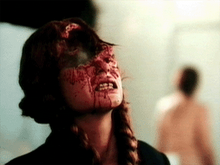
#89: Strange Behavior (Michael Laughlin, 1981)


A few minutes into Strange Behavior, I smiled and thought to myself, "This movie was made by interesting people." That thought continued for the rest of the movie's running time. This is a weird, forgotten gem that deserves more attention, and anyone who dislikes it should be battered with large objects and thrown off a couple of bridges.
A slasher/mad scientist hybrid set in Galesburg, Illinois but filmed in New Zealand during the creative height of 1970s-80s Australian and New Zealand exploitation cinema called Ozploitation (see the entertaining documentary about this scene, Not Quite Hollywood), Strange Behavior contains a smart, considered visual style, rich characterization from everyone including even the tiniest roles, and a mix of satisfying genre cliches and bizarro weirdness unique to this project. If you want to quibble, there are some continuity errors, unexplained occurrences, and a few stiffly delivered lines, but, on the whole, this is the kind of buried treasure I'm always on the hunt for as an obsessive movie lover.

In the small community of Galesburg, life is sleepy and content until some teenagers get carved up by what the police think is a deranged whacko until the evidence points to multiple deranged whackos. Why is this happening in Galesburg? Meanwhile, at Galesburg College, some bizarre experiments are taking place in the psychology department. Late professor Dr. Le Sange's work is continuing, even though he's been dead for three years. All his lectures have been recorded on film, so he's still teaching from beyond the grave, and his protege Dr. Parkinson is continuing his work. Are these victims and killers somehow connected to the experiments and events related to these experiments from 17 years ago? Take a wild guess. Meanwhile, the chief of police, John Brady, and his teenage son, Pete, get deeply involved in the mystery, unbeknown to each other.

The cast is excellent, except for a handful of people who have just one line. Each character is layered, complex, and refreshingly un-Hollywood. Michael Murphy, best known for appearing in multiple Robert Altman and Woody Allen films, plays the police chief. He's an obsessed, stressed-out guy, which is all we'd learn about him if this were a conventional movie. Instead, we also see his wicked sense of humor, his kindness, and his close relationship with his son. Louise Fletcher plays his girlfriend. She's still so identified with her most famous role, Nurse Ratched in One Flew Over the Cuckoo's Nest, that her varied talents are often overlooked. Here, she plays a warm, likable woman who couldn't be more different from Nurse Ratched. Dan Shor, best known to my generation as Billy the Kid in Bill and Ted's Excellent Adventure and Ram in TRON, plays Murphy's teenage son Pete. He's smart, charismatic, and funny, and a weird combination of popular jock and punkish, skinny-tied new waver. In fact, all the characters are smart and unusual. They have personality, instead of being movie personalities. Other favorites of mine include Hollywood legend Charles Lane as the police chief's elderly clerk (Murphy: "Where'd you get that tie?" Lane: "Munky Ward's"), Marc McClure as Pete's teenage buddy Oliver, Jim Boelson as Waldo, the annoying guy in class who looks like he's 40 and always ruins the party, and horror movie pinup queen Fiona Lewis as the sexy and sinister Dr. Parkinson. I love this cast.

Director Michael Laughlin, in his debut, does a lot of interesting things, structurally and formally. In almost every scene, the camera frames the action in a mostly stationary medium shot, so we can see the characters interact with each other and see the physical space they're moving around in without being forced to take any character's point of view. These shots ensure a certain detached objectivity, which creates a physical space for the audience to form its own judgments and make its own choices about what to look at in the frame. Closeups are eschewed until the final two scenes, in which our relationships to the characters are fully earned and invested with carefully developed feeling. At the same time, Laughlin nudges us into feeling a little uneasy and off-kilter by positioning his camera in these shots either slightly above or slightly below the action, as if we were sitting on a chair that's just a little higher or lower than the rest of the table. It's subtly discombobulating. When Laughlin does move his camera during a few crucial scenes, the effect is startling. These scenes really take off and stand out.

One of these scenes takes place at a costume party and has immediately become one of my favorite scenes in the movies after just a single viewing. It's the kind of scene that does nothing to further the plot and everything to justify this visual medium's existence. It's a ridiculous, exciting, visceral, unexpected visual pleasure that makes me love the art of film. Our teenage characters, Oliver and Pete, attend a costume party dressed as skinny-tied new wavers commonly found playing bass in The Knack, Tubeway Army, The Damned, or some other late-punk/early-new wave combo of your choice. As they enter a room full of teenage cowboys, nurses, vampires, Batmans, Robins, etc., Lou Christie's "Lightnin' Strikes" begins to play. The teenagers sloppily and jokingly dance around for a few minutes in a half-assed fashion before slowly growing more enthused until, finally, the whole party comes together in a giant, choreographed dance routine as Christie's crazy falsetto launches into that final, kick-ass, uber-pop chorus. The camera glides through this party gracefully as the dancing turns from sloppy to organized. When the song ends, the dancers fall back into normal, sloppy teenage mingling. What a lovely, magic scene. It's cinematic Red Bull, and the kind of scene that exists for no other reason but its own awesomeness. You know you're in the hands of filmmakers who are comfortable eating their own boundaries.

Director Michael Laughlin has had an erratic but interesting movie career. He directed two other films, an alien invasion movie called Strange Invaders that I'm really excited to see now and a drama about a teenage girl forced to marry a creepy older man called Mesmerized, which Laughlin wrote with acclaimed Polish filmmaker Jerzy Skolimowski (who had a rare acting role in Cronenberg's Eastern Promises). Laughlin also produced Monte Hellman's cult classic Two-Lane Blacktop and the Warren Oates-starring Raymond Chandler homage Chandler. His last movie job was the massive flop Town & Country, which starred Warren Beatty and was written by Laughlin and Buck Henry. Laughlin's producer and co-writer on Strange Behavior was Bill Condon, who has gone on to be a successful Hollywood director and screenwriter. Condon also co-wrote Laughlin's follow-up, Strange Invaders, and the Oscar-winning movie based on the hit musical Chicago. As a writer/director, Condon got his start with a bunch of TV movies and the job of work sequel to Candyman called Candyman: Farewell to the Flesh. That movie sucked, but Condon bounced back with Gods and Monsters, an excellent little drama/historical fiction about the final days of film director James Whale and his unrequited crush on his pool boy. Condon also directed Kinsey and Dreamgirls and is on tap to direct the next two Twilight sequels and a Richard Pryor biopic. I still think his finest work is that party scene in this movie.
Bonus points: The soundtrack, besides Lou Christie's immortal, unstoppable pop hit, includes great songs from The Birthday Party and Pop Mechanix, and a score by Tangerine Dream. The first murder victim is wearing a Nebraska Cornhuskers sweatshirt. I love that a kid wearing a shirt of my alma mater's football team takes a knife to the eyeball.

Saturday, July 24, 2010

#88: Stir of Echoes (David Koepp, 1999)


Maybe I sound like an angry old man bemoaning the state of the world because he no longer keeps up with it, but something bad happened to mainstream Hollywood filmmaking in the first decade of this new century. This badness didn't originate in the 2000s and is really an amalgam of all kinds of cultural influences and changes that aren't necessarily bad in and of themselves (French New Wave, 1970s auteurist cinema, Pop Art, 1980s and 1990s blockbusters, music videos, television, commercials, video games, the Internet). This synthesis of influences, combined with an influx of producers, studio chiefs, and actors with little knowledge of film history (audiences, too) and a move from director-as-auteur to producer-as-auteur and director-as-ringmaster, has led to a crippling uniformity of visual style (dizzyingly quick cuts, zero character development, spatial incoherence, lack of structure, bloated running times, overloaded special effects, every scene a climax, no space for an audience to ever look at anything). This style is often compared to video games, but most video games use the physical, visual space of their landscapes in competent, coherent ways. Instead, Hollywood films are trying to compete with video games by bombarding an audience with enough stimuli to kill a miniature pony. The Stage 5 cancer proliferation of remakes and big-screen versions of television franchises and the return of the unnecessary, screen-dimming 1950s gimmick 3D aren't signs that these fuckers have run out of ideas. They're signs that these fuckers never had any ideas to begin with. (Aside #1: This is a Hollywood era in which Christopher Nolan is regarded as an important director, but do any movies make less visual sense than his two Batman adaptations? I'm disappointed at all the interest my friends have taken in Inception, which I admittedly have yet to see, but, seriously, the guy can't film an action sequence to save his ass. Did he learn how after The Dark Knight? Would you learn how if no one cared except for a small army of film lovers like me? Yeah. Me, either. Crotchety get off my lawn fogeyisms again, maybe, but I just wish the general audience cared more about film history, visual space, and structure than bombardment of spectacle and flattery of preconceived expectations. Give yourselves more credit, people. You can handle it. Most of you deserve it. I like this recent quote from a critic I'm not particularly a fan of, Salon's Stephanie Zacharek: "If the career of Christopher Nolan is any indication, we've entered an era in which movies can no longer be great. They can only be awesome, which isn't nearly the same thing.") (Aside #2: To prove that this isn't just fogeyism on my part, I want to say that there are amazing films being made in the present by people in Iran, Japan, France, Spain, South Africa, right here in the USA, etc., that are consistently overlooked by most of the people going to Inception. It's a chicken-and-egg thing, my blaming of Hollywood and its audience.)

All this complaining is a long way of introducing a review of a fairly routine yet satisfying ghost story filmed in the final year of the final decade so far in which mainstream American films made any kind of visual sense (noting, of course, the handful of exceptions every year, mostly comedies, that don't whack you in the face with a Bedazzled 2x4 for 2.5 hours). Stir of Echoes is a film with a lot of cliches and a lot of flaws, but it's also a finely told, smartly directed, empathetically acted scary horror/thriller with a real sense of place. The film seems like it was written at one of those Screenwriting 101 seminars, but ghost stories are a breed of subgenre that can thrive within their tropes and revel in the late-night campfire tale qualities of their conventions. There are really only a few ghost stories, anyway. Ghosts are usually a) haunting the person who did them wrong, b) haunting the person who can reveal their mysteries and save them from limbo, or c) haunting anyone who stops by because they want to stir up some shit and/or get revenge. Stir of Echoes concerns itself with the second option.

Kevin Bacon (Oracle of Bacon number: zero) stars as Tom, a lineman (not a Wichita lineman) in Chicago still holding on to his dreams of rock stardom (or at least punk rock cult stardom). He and his wife, Maggie (Kathryn Erbe), are very close, but she's the practical one who keeps everything together. They have a son, Jake (Zachary David Cope), who, in an unfortunately timed coincidence, sees (and hears) dead people. (This movie was in development and filmed about the same time as The Sixth Sense and was based on a Richard Matheson novel that predated Shyamalan's movie by many years, but Stir of Echoes still suffered an undeserved copycat reputation that hurt it at the box office.) Maggie has an unfortunately written bohemian sister, Lisa (Illeana Douglas), who is working on becoming a licensed hypnotherapist. I like Douglas a lot as an actress, but she's saddled with what my wife calls the "Joan Cusack role" here. She's the kooky, eccentric sister who has to deliver undeliverable lines like the following, upon learning that Maggie is pregnant: "So, she's six weeks pregnant. That means the baby's due in... April, May... June. Gemini. That's cool. Einstein was a Gemini. So's that Scottish gal from Garbage." Ugh. Douglas does the best she can with a part that's a collection of screenwriter tics. (Screenwriters, why does the neighbor, sister, and/or best friend character always have to be kooky?) Fortunately, the rest of the cast is much more developed and interesting. Anyway, at a neighborhood party, Tom tells Lisa to hypnotize him, she does, and bad shit starts to go down in the following days. Tom begins hallucinating a ghostly teenage girl, starts to realize Jake's imaginary friend may not be imaginary after all, and goes quickly insane. For some reason, he starts drinking gallons of orange juice every day. Don't ask me why. The rest of the movie concerns Tom's efforts to solve the mystery of the ghost girl and his wife's efforts to keep the family together.

Writer/director David Koepp is one of the most successful screenwriters in Hollywood and much in demand, especially by Steven Spielberg and Brian De Palma. His writing credits include Bad Influence, Jurassic Park, Carlito's Way, Mission: Impossible, Snake Eyes, Panic Room, Spider-Man, War of the Worlds, and the recent Indiana Jones and Da Vinci Code sequels. As a writer/director, he also made the Stephen King adaptation Secret Window and the Ricky Gervais comedy Ghost Town. Despite his primary career as a writer, his work on Stir of Echoes is stronger in the directorial department. The story is your basic Hollywood three-act structure, and a lot of what's supposed to happen in these kinds of stories happens. Aside from a terrible soundtrack of late-'90s corporate alternative schmucks (Moist, Dishwalla, etc.), Koepp does a fine job telling this story visually and aurally, avoiding heavy-handed stylization, quick cuts, and flashy tricks. He shoots on location in a real Chicago neighborhood, even though the film mostly takes place in a few locations and could easily have been shot in a studio. Location voodoo is a real thing, and I love it when people shoot on location. Bacon, Erbe, and Cope are convincing playing a family, and Erbe has a rare horror movie mother role that isn't just mothering, running, screaming, and receiving protection from the husband. The film's climax is a bit overblown, neat, and pat, and a Beth Orton musical montage in the penultimate scene pushes the cheese factor too far (I like some Beth Orton songs, but any music with lyrics at a film's conclusion can topple what's been carefully built). However, the film's final scene redeems the climax with a nice little creepy, unsettling jolt. I like this movie.