Saturday, June 15, 2024

Deadtime Stories (Jeffrey Delman, 1986)

Deadtime Stories is a low-budget horror-comedy anthology that's only intermittently funny, not too scary, and pretty damn stupid, but its goofy charm won me over. In spite of myself, I had a good time with it. It's silly, silly stuff, but it knows that and runs with it. I can't really recommend it to anyone but '80s horror completists and people who are able to tap into their inner 13-year-olds, but that's most of us, right?
The anthology's connecting story/conceit is about pervy, beer-swilling Uncle Mike, who's stuck babysitting his nephew, Little Brian. Uncle Mike is trying to pound some beers, eat some chips, and watch the Miss Nude Bayonne contest on cable TV, but Brian keeps waking up and demanding bedtime stories. This kid sucks, though kudos to actor Brian DePersia for playing the part like a regular kid instead of giving one of those cloying child-actor performances. We then see the age-inappropriate stories Uncle Mike freestyles/adapts from fairytales for his nephew. The first one is an original tale of witchcraft and human sacrifice, and the second and third are loose adaptations of "Little Red Riding Hood" and "Goldilocks and the Three Bears."
Each of the three stories has a different tone and feel. The first has a children's fairy tale vibe (except for the gore effects and sexual content) despite being the only story not adapted from a fairy tale, the second takes a more traditional horror movie approach, and the third is a cartoonishly violent gross-out comedy in the Troma vein. I found something to enjoy in each one, as well as at least one scene that made me ask myself why the hell I was still watching.
Fortunately, Ed French handled the special effects. The narrative sometimes fails, the seams of the low budget sometimes show, but the big effects sequences are all well done, with French delivering the over-the-top goods. French's list of credits in both mainstream and independent filmmaking are lengthy and impressive, but my personal favorite is the time he got to decapitate himself in bonkers Thanksgiving-themed underground classic Blood Rage (starring Louise Lasser!!) when he pulled double duty as actor and special effects guy. Sir Ben Kingsley could never.
The first segment stars Family Ties' Scott Valentine as Peter, the slave of a couple of witch sisters named Hanagohl and Florinda. He assists the witches with spell recipes and manual labor, but he starts getting bummed out after procuring a human sacrifice and learning there will be even more murders as part of a plot to find and reanimate the third witch sister, Magoga. When the attractive and charming Miranda is the next sacrifice target, Peter starts hatching a secret plan of his own. This is the cheapest-looking and least initially satisfying of the stories, and at moments, I felt like I was watching a boring kid's show or a small-town community theater performance. I generally love witch horror, but when it gets a little too bubble bubble toil and trouble, I check out. I like the sexy witches, the folk-horror witches, the terrifying witches, and the mysterious witches, but the hag witches making potions and/or the broomstick witches are for the kids. I'm a sophisticated adult who needs suitable witches for a gentleman of my age and discriminating taste. The witch story picks up when Magoga enters the picture, and Ed French saves the day with a pretty awesome transformation effect. It gets silly again after that, but it's a bit more fun.
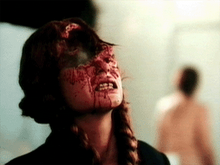
The second story, a spin on the Little Red Riding Hood tale, has more grit and visual texture and is the closest to then-contemporary horror. Sexy 26-year-old high school senior Rachel (Nicole Picard) has the slowest and strangest sexual fantasy in front of a mirror in her bedroom (why are you telling this story to your little nephew, Uncle Mike?) until her mother tells her she needs to pick up her grandmother's prescription from the pharmacy. She puts on her red tracksuit and jogs down there, where she encounters fellow customer Willie (Matt Mitler, veteran of such cult films as The Mutilator, Breeders, and Basket Case 2). Willie is a leering hoodlum with a drug habit, and the shady pharmacist accidentally swaps his "prescription" package with Rachel's grandmother's legit prescription. Willie goes to grandma's house to get his narcotics, Grannie gives him the business, and he turns into a damn werewolf. Meanwhile, Rachel takes a detour on her way to Grannie's to lose her virginity to her dweeb boyfriend on an air mattress in a tool shed before finally getting some werewolf action of her own. This is pretty standard '80s horror fare, but the wolf effects are cool, the red tracksuit really pops onscreen, and the locations have excellent horror movie atmosphere.
The third story is weird, weird stuff, with an early role for Melissa Leo, who would go on to much greater success. The Baer family (pronounced "bear," get it?) are locked up in an insane asylum for their many violent crimes. Mama Baer (Leo) gets her hands on a car while Papa Baer (Kevin Hannon) and their dimwitted son Baby Baer (Timothy Rule) get a gun. Even though Melissa Leo and Kevin Hannon were in their twenties in 1986, they were cast as the middle-aged Baers, complete with bad wigs. The Baers bust out of the asylum after overpowering a security guard played by Rondell Sheridan, a comedian who would later star on the sitcom That's So Raven. I'm sure you're all huge That's So Raven fans.
While the Baers were locked up, another escaped lunatic, Goldi Lox (Cathryn de Prume), has been squatting in their abandoned, dilapidated house along with the dead bodies of dozens of former boyfriends who tried to get too handsy with her and had to be murdered. Goldi Lox is a homicidal maniac who also has telekinetic powers, for some reason, and when the Baers arrive in their old homestead and find Goldi Lox in the shower after an extended breast-rubbing shower scene, they decide to let her stay and join the family. They go out for pizza because the porridge is too cold, and mayhem ensues. Only about one joke out of ten lands in this last story, but the whole thing is so weird and so stupid that I had no choice but to be entertained. I especially liked the answer the chief detective gives when a reporter asks him his strategy about how to handle Goldi Lox's murder spree: "Well, we plan to arrest her and of course put her in jail. That oughtta do it."
Deadtime Stories is far from an essential classic, but it's reasonably well made despite its first-time director and bare-bones budget, the special effects are good, and the interior settings have a personalized, lived-in feel. This is not exactly a "good" movie, but I had a good time with most of it, even the ultra-cheesy musical score.

Friday, May 31, 2024

The House of Fear (Joe May, 1939)

A remake of the 1928 Paul Leni silent film The Last Warning (reviewed on this site several years ago), The House of Fear is yet another thriller set in the backstage world of the theater, a popular setting for mysteries and horror films in the '20s and '30s. It's a pleasantly entertaining movie that is not particularly special or memorable except in fleeting moments, and I don't have much to say about it, so this may be a shorter post than usual.
Retaining most of the 1928 film's narrative, The House of Fear is about an actor who drops dead mid-performance at a Broadway theater. His body disappears by the time the police arrive and is never found. The theater, owned by a pair of polar-opposite brothers (one a brusque, hulking middle-aged man with a tough-guy East Coast accent and the other a wimpy young guy with an inexplicable British accent), closes its doors after the scandal until an enterprising regional theatrical producer scrounges up enough financing to stage the same cursed play in the same location, with as much of the surviving cast as he can rehire. (The silent film had the reopening take place five years after the mysterious death, but this version shortens it to one year.)
The "producer" is actually an undercover detective trying to solve the murder, and he commits fully to the theatrical life, charging expensive cigars to his department so he can look the part of a Broadway producer. Oh, this makes his chief so mad. The guy's about to blow his top at these expenses! It's funny that the exasperated police chief has been a stock character in film for at least a century. These guys are always so mad at their detectives' antics while having to acknowledge that their unorthodox methods get results, damn it. It doesn't matter what decade it is or what's going on politically. Something about this cliché is deeply comforting to filmgoers' psyches. It's not just American movies, either. I've seen these characters pop up again and again in so much of world cinema.
Once most of the actors and crew are rehired and rehearsals start rolling, weird threats in the dead man's handwriting and even his own voice begin to appear. Could it be a gh-gh-gh-ghost? Soon, secrets about love triangles and feuds are revealed and hidden passageways are found. Another murder takes place under everyone's noses, and nefarious schemes are revealed, leading to much action and frantic exposition. The police chief gets even more exasperated. A character swings on curtains and ropes with considerable pizzazz while being chased. It all wraps up in an economical 67 minutes.
The House of Fear is difficult to write about. It's enjoyable and breezy, a couple clicks above mediocre, but it's not particularly special. (It did go over budget and over schedule, though, so there may be some behind-the-scenes juicy gossip.) This kind of thing has been done much better and much worse, and Joe May is neither a cinematic genius nor a soulless hack. It's a movie! You may like it if you like movies!
Joe May was an Austrian (real name Joseph Mandl) who got his start in the film business in Germany. May had a great reputation as a pioneer of German film, and he gave Fritz Lang his big break when he hired Lang as a screenwriter. Fleeing Germany for the United States in 1933, May ended up making b-movies for Universal.
More of a director-for-hire in the States, May saw many of his European peers eclipse him in Hollywood, and his life was full of hardships, particularly the death of his actress daughter Eva in 1924, whose biographical details seem ripped from a paperback melodrama (she was divorced three times from three different movie directors by age 22 and had one boyfriend leave her for Marlene Dietrich and another refuse her marriage proposal; she survived one suicide attempt and died from the other), his 1933 exile from Germany due to the Nazi regime, the business failure of the unsuccessful restaurant he and his wife opened in Los Angeles after he retired from filmmaking in the mid-1940s, bankruptcy, and a lengthy illness.