Saturday, April 8, 2017

4/8/2017: Laughing Men and Black Gestapos

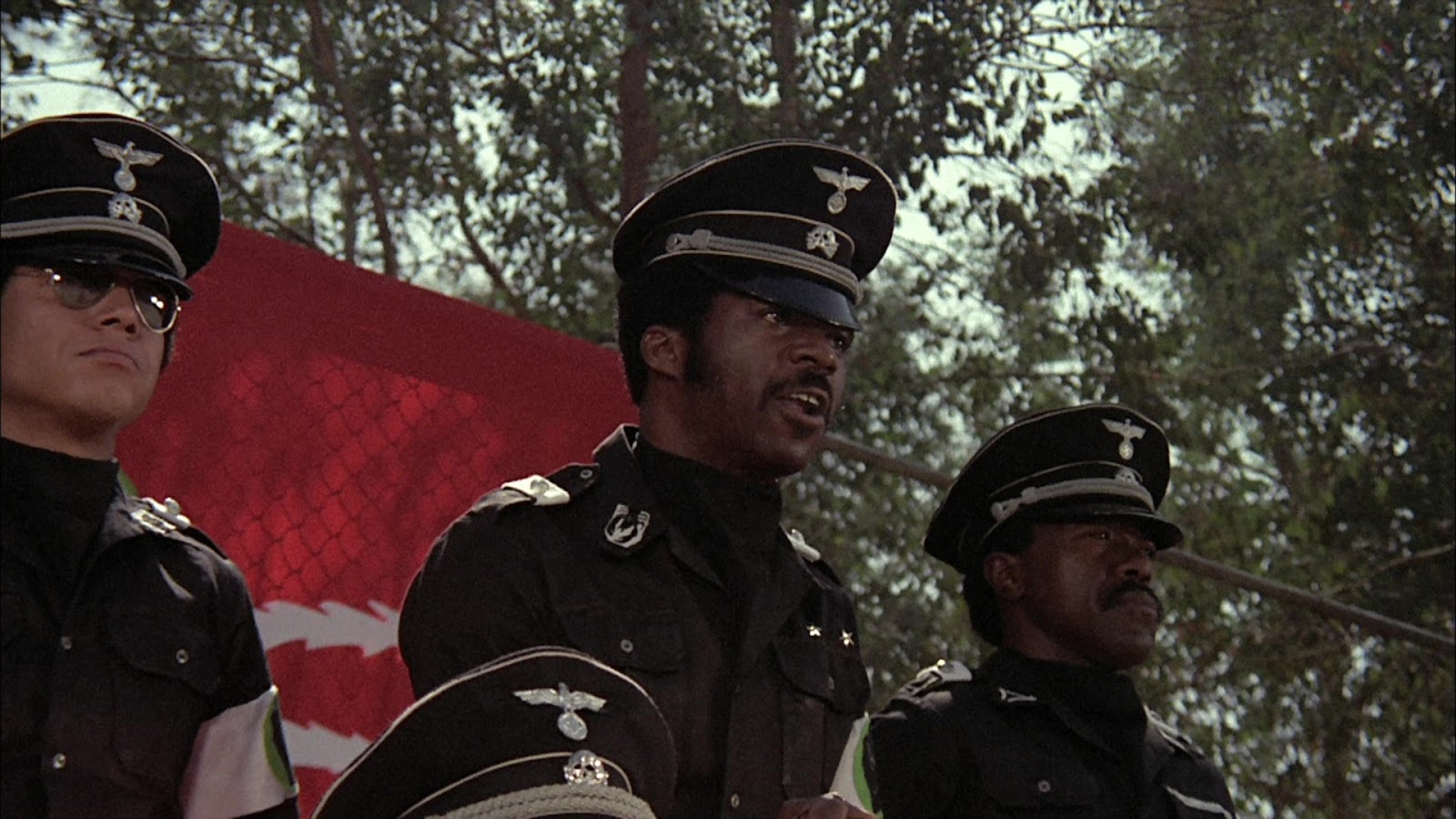
The Black Gestapo (Lee Frost, 1975)
An intriguingly oddball blaxploitation film, The Black Gestapo is more successful in concept than execution. The plot is pretty unusual. Set in Watts, the film is about The People's Army, a black power community activist organization that models itself after the military and has its own hospital. Tension exists between the group's leaders, Gen. Ahmed (Rod Perry), who wants to work within the system and avoid violence, and Col. Kojah (Night Court's Charles Robinson), who sees the need for direct revolutionary action, including violence if necessary. When some white gangsters start leaning too hard on black businesses and selling dope in the neighborhood, and a couple of their goons rape a black nurse, Ahmed gives Kojah the go-ahead to organize a small group to run the gangsters out of town. Kojah succeeds but turns mad with power, becoming a gangster and drug lord himself, and the stage is set for a People's Army civil war. As a historical curiosity, the film is fascinating, but the directing and acting are pretty amateurish, and the director spends too much time dwelling on sexual violence against women in ways that let you know he's getting off on it at the same time that his story is condemning it. That director, Lee Frost, had a lengthy career in exploitation, and his two best-known films are probably The Thing with Two Heads, starring Rosey Grier and Ray Milland, and moonshiner revenge Southernsploitation, Dixie Dynamite, starring Warren Oates.
The Man Who Laughs (Paul Leni, 1928)
The mid- to late-1920s was a golden age of silent film, when poetic vision, technology, and technique had advanced together, and visually stunning masterpieces were numerous, before early sound made things clunky, stagy, and awkward again for a few years. The Man Who Laughs is one of these masterpieces. Based on a Victor Hugo novel, The Man Who Laughs combines elements of horror, comedy, romance, tragedy, swashbuckling adventure, historical costume drama, German expressionist influence, and the sad clown and life of the traveling performer stories to create a thrilling classic Hollywood entertainment. I saw this years ago and admired it without loving it. I don't think I was in the mood for a silent film then, because this second viewing really bowled me over. It's a gorgeously composed movie, full of great images and scenes (director Leni also made Waxworks and The Cat and the Canary), and producer Carl Laemmle's goal of making a film that blended the tones of The Hunchback of Notre Dame and The Cabinet of Dr. Caligari was mostly achieved, though all three of those films stand on their own. Besides the composition, this is also a film of great movie faces, particularly Conrad Veidt's in the title role.

Saturday, March 11, 2017

3/11/17: Ch-ch-ch-changes

Hey friends. This blog is 10 years old, and I've written 250 movie reviews for it. I've enjoyed doing it, but it's time for a change. When I started it, I gave myself the schedule of writing a long-form post at least twice a month, so I've essentially given myself homework every other Saturday for a decade. I can tell that I'm starting to repeat myself and sometimes phone it in, and what used to be enjoyable is turning into a bit of a chore. My temporarily insane work schedule and my life and the world are making it hard to keep it going in the same way. Instead of calling it quits, though, I have decided to post once a month and make the posts shorter. I'll be covering two films at once. Here's the first batch in the new order. I may go back to the original posting schedule at some point in the future, and I may not.

The Fall of the House of Usher (Jean Epstein, 1928)
This Edgar Allan Poe adaptation by French director, avant-garde theorist, literary critic, and novelist Jean Epstein was co-written with Luis Bunuel, who would go on to become one of the greatest directors in world cinema. Epstein is pretty great behind the camera, too, as this film and The Three-Sided Mirror prove. Though Epstein and Bunuel give the story a more subdued conclusion than Poe's, the film as a whole is a surrealist nightmare of romantic decay, full of elegant, gothic rot and a gauzy, waking dream-state atmosphere. It's a creepy film that looks and feels outside of time. It's a bit hard to find these days, but well worth tracking down.

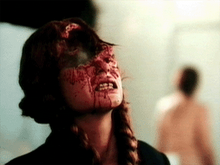
A Blade in the Dark (Lamberto Bava, 1983)
This delightfully bonkers Italian slasher film, directed by Lamberto, son of Mario, is visually perverse and thrilling and narratively as stupid as a box of tennis balls, with some of the most ridiculously odd, poorly translated-into-English dialogue of the '80s. It's like they translated each line, word-by-word, with an Italian-to-English dictionary, ignoring things like slang, common usage, and words with multiple meanings. (Sample dialogue: "Is this all the whiskey you possess?" "I like musicians. They're good in bed. How are you in the feathers?" "Don't begin with me. Please, don't begin with me. I told you not to begin with me." The lead character calls his girlfriend a "vacant nerd." A woman says she's scared of spiders. "That's not a spider, that's a cockroach." Camera clearly shows a spider.)
It's a pretty good setup for a slasher film. A film composer writing the score for a horror movie holes up in an isolated Italian villa to work, but a series of bizarre murders may or may not be happening inside the house. Many red herrings ensue. Bonus progressive points: the character of the horror movie's director is played by a woman, and she is presented without condescension. It's a given in this film that women directing movies is perfectly normal and no big deal. (We're still waiting for that to be true in the real world, or at least whatever simulation of the real world we're currently living in.) Minus progressive points: (SPOILER ALERT) the killer is a man in drag who has both male and female personalities (played by the director of Cemetery Man, Michele Soavi). I've often found this trope effectively scary in slasher films, but I also think it's exploited a lot of our inherent societal prejudices and made things tougher for trans people in the larger picture. I don't think it's presented in bad faith here, and this movie, despite being very silly, has a much more interesting approach to gender than most slasher films, but life is complicated, and I don't know where I'm going with this, so sentence ended.
P.S. One of the actors in this film has one of the great names: Stanko Molnar.