Saturday, December 4, 2010

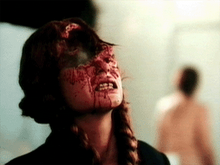
#97: Urban Ghost Story (Genevieve Jolliffe, 1998)


This low-budget Scottish film, though not without its problems, is a solid, enjoyable haunted house/social realism hybrid that convinces in both its modes for most of the running time. Take out the haunted house story, and you have a compelling drama about a 12-year-old girl, her young half-brother, and her single mom living in a Scottish tenement full of drug addicts, criminals, and the working poor. Take out the drama, and you have an atmospheric poltergeist story. Put them together, and you have a comedy about a lovable Sasquatch who moves into the household and turns it upside down. Wait, forget that last part. What you do end up with is a movie that successfully blends its genres into an organic whole.

Urban Ghost Story is full of memorable characters, and 12-year-old Lizzie (Heather Ann Foster) is the pivotal one. A smart, angsty pre-teen, she and another friend from her building decide to grow up a little too fast. The two middle school tenement buddies make some poor decisions that are a little advanced for their tender ages, including joyriding in the boy's father's car while loaded on vodka and ecstasy. These things tend to end poorly, and this is no exception. She survives the terrible car accident, though she is clinically dead for three minutes. She's left with a bum leg, but her friend isn't so lucky. He's trapped in the burning car and gets incinerated.

Lizzie is left with a wicked case of survivor's guilt and a poltergeist who may or may not be the spirit of her dead friend. Furniture starts moving around the bedroom she shares with her little half-brother Alex, his bed covers jump off the bed by themselves, and some invisible something scratches the walls and pounds on the doors. Her stressed-out single mom Kate thinks Lizzie is responsible at first, but soon changes her mind. She reports the events to the police and social services, but no one believes her. In desperation, she stupidly turns to a tabloid reporter she thinks believes her. He sees a marketable story to exploit and temporarily moves in to milk it for all its worth. The apartment is soon crawling with paranormal investigators and psychic mediums. Fun fact: the reporter is played by Sean Connery's son, Jason Connery, who has a much subtler Scottish brogue than his old man.

Things are tough for the family. Social services is investigating the mother for possible child abuse and neglect, a group of hired thugs led by Billy Boyd of Lord of the Rings fame comes calling for a debt, and Lizzie is hanging out with a teenage mom/druggie who is another of the tenement's many bad influences. Meanwhile, the ghost becomes more aggressive. These story strands are fleshed out and compelling until the final third of the film, but I'll get to that later.
Director/co-writer Genevieve Jolliffe has a nice eye for detail and shot composition, and her characters are three-dimensional and well written. The cast is uniformly strong, and their Scottish accents are so cute. That's a little condescending, I know, but I love a Scottish accent. The most terrible news sounds heartwarming when delivered in a Scottish brogue.

I'm recommending this film, but I have a few reservations. The soundtrack is occasionally oppressive. There are nice moments when Lizzie has her headphones on and we get a blast of the industrial metal she loves, but other instances of loud score are less organic to the story and punch scenes harder than they need to be punched. The film's final twenty minutes seem rushed and a little forced. The filmmakers seem to have realized, "Oh shit! We need to conclude these story strands! And fast! 23 skidoo, gang!" Plot points are resolved in a dizzying array of activity. The film is only one hour and twenty minutes long, so an extra ten minutes to conclude things less frantically wouldn't have been excessive. Despite these quibbles, Urban Ghost Story is an unfairly overlooked film that mostly succeeds as a social drama and a horror movie. I liked it.

Saturday, November 20, 2010

#96: The Unearthing aka Aswang (Wrye Martin & Barry Poltermann, 1994)


NOTE: This film is available on video and DVD under both its original title, Aswang, and The Unearthing. I had a much easier time finding it under Aswang.

This low-budget horror film made by two college buddies from Wisconsin for under $200,000 is well worth your time. Based on a Filipino vampire legend (coincidentally, I was drinking a Filipino dark lager while watching it), The Unearthing/Aswang shares some tonal, atmospheric, and visual similarities with early Cronenberg, the first two Evil Dead films, and the darkest childhood fairy tales. While it doesn't come close to early Raimi and Cronenberg at their best, it's pretty damn good in its own right and certainly better than the majority of mainstream films, including Gone with the Wind, Daddy Day Care, and Event Horizon. Aswang is low-budget without being cheap and amateurish, darkly funny without being campy, truly weird without being affected or "quirky," and honestly unsettling and scary.

Aswang begins with a young woman discussing her unplanned pregnancy with her mildly mulleted metalhead boyfriend. Check out that alliteration. She has decided to sell the child to a couple who can't have a baby, with a slight catch. She will also be paid to pose as the wife of the couple at a rural Wisconsin mansion owned by the man's sickly mother so he can inherit the property. As he tells the young pregnant woman while they drive to the mansion, his mother won't leave him anything in the will if he doesn't produce an heir. Things get sinister when they arrive at the mansion, which looks like it was designed by Stanley Kubrick. The only inhabitants are the sickly mother, who keeps sucking on oxygen, a strange Filipino maid named Cupid, and an exotic white chicken who roams the premises freely. Oh yeah, there's also an unseen sister who lives in a cottage out back. Apparently, she's "a little touched." At this point, I'd probably call a cab and head back home, especially after seeing a painting of an aswang, a Filipino vampire who drinks the blood of newborns, given prominent place in the study. Fortunately, our heroine sticks around, ensuring our enjoyment of a fucked-up, unusual vampire movie.

First-time filmmakers Wrye Martin and Barry Poltermann wrote and directed Aswang together, and they did an admirable job of creating a lot with a little. Working with a cast of amateur non-actors, including Violent Femmes drummer Victor DeLorenzo as a bumbling sheriff, they get mostly naturalistic performances. Even the few awkward actors add to the film's weird texture. The directors have a nice eye (they share one giant eyeball), and though they're clearly new at the filmmaking game, they avoid a lot of dumb-ass overstylization and clumsiness. The film is loaded with atmosphere, too. A creeping sense of dread slowly increases, the house and the rural Wisconsin countryside are great horror movie locations, and the directors and their editors use sound and visual space well. The special effects are convincing, too, which isn't always the case in super-low-budget filmmaking.

I don't want to give too much away, so this review will be a little short. The movie's pleasures and surprises deserve fresh eyes and ears, and I don't want to diminish the Aswang experience. (That's what she said.) I'm a big fan of regional independent movies, and Aswang is a fine example of the creative freedoms possible within the financial limitations of non-Hollywood filmmaking. Joe Bob Briggs likes Aswang, too, so it's got that going for it.
Writer/directors Martin and Poltermann have remained active in independent filmmaking. Martin now works as a producer. Poltermann directed one other film, The Life of Reilly, a documentary about Charles Nelson Reilly's one-man show, and has enjoyed a long relationship with director Chris Smith as his go-to editor, working on American Movie, The Pool, and Collapse. I admire their later work, but I think these guys need to get back together and make another horror movie. Aswang is too good to be a one-off.