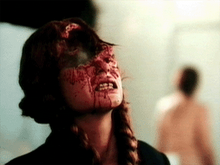
This is a hard film to write about. For one thing, it's not a good film. For another, it's not a bad film. It's not a mediocre film, either. It's strange. It's got some wonderfully filmed and orchestrated set pieces and some curiously flat and aimless moments as well, but the tone and pacing remain consistent, never upset by the movie's strengths or weaknesses. The dialogue is full of leaden cliches that no people except movie characters ever say, including "We have much in common, you and I," but the film is also light on exposition and generally nicely and wittily underplayed, except for a Frank Langella freakout near one of the 10 or 12 climaxes (this film has more presumably final scenes than the third Lord of the Rings movie). The Ninth Gate is slowly paced and long, though it never gets boring. It never really goes anywhere, either, though. It's narratively unsatisfying, yet always pleasant and watchable. The film is seriously flawed, but its flaws exist peacefully alongside its strengths, creating an odd but cohesive supernatural thriller that is disappointing as a Polanski film, entertaining as a minor yet relaxed and understatedly comic genre film, and a lot more interesting than your usual Hollywood production.

Polanski is an interesting guy with an impressive filmography and a wild and often tragic life. Growing up Jewish in Poland during World War II, he was forced into the Krakow ghetto, along with his parents. His father was placed in an Austrian concentration camp and managed to survive the war, but his mother was taken to Auschwitz and murdered. Polanski himself escaped the ghetto at the age of 10 and roamed the Polish countryside for the remainder of the war, sleeping in barns and receiving shelter from Catholic families. He attended film school in Poland during the Communist regime and made his early short films and feature film debut there, but quickly moved to France. He's been an international director ever since, making films in many different countries. His years in the United States produced some of his greatest films and more personal turmoil and tragedy. In August 1969, while Polanski was in London, Polanski's wife, actress Sharon Tate, and several friends were murdered by the Manson Family. (The 40th anniversary of the killings was last week.) In 1974, Polanski photographed a 13-year-old model for French Vogue at Jack Nicholson's house. After plying the girl with champagne and quaaludes, he either coerced her into sex or forced himself on her, depending on which of the many versions you believe. Everyone, including Polanski, admits he did a very fucked-up thing. Polanski skipped the country after spending 42 days in a psychiatric facility. He settled in France, where the government refuses to extradite Polanski. He hasn't been back to the United States or England since then. The model, Samantha Geimer, has forgiven Polanski and thinks he should be allowed back in the U.S. She says she believes he's sorry for what he's done and has paid for his crime.

Inextricably connected to his messy, tragic, and somewhat creepy personal life are his often amazing films. He's made a lot of great movies: Knife in the Water, Repulsion, Rosemary's Baby, Chinatown, and Tess, as well as a lot of less-than-great but still pretty good films like Macbeth, The Fearless Vampire Killers, and Death and the Maiden. I still need to catch up with his other highly regarded films like Cul-de-Sac, Che?, The Tenant, Frantic, Bitter Moon, and the movie that got him his first Oscar for directing, The Pianist.
The Ninth Gate doesn't belong in that pantheon. It's easy to say while watching it, "This is the guy who made Chinatown?" A critical and commercial flop during its theatrical run 10 years ago, though not a disaster on par with Polanski's biggest flop, Pirates (1986), which cost $40 million and made less than $2 million, nearly bankrupting the studio, The Ninth Gate is minor Polanski. However, as I said earlier, this movie is always watchable and very, very strange. Johnny Depp stars as a rare book dealer/book finder in New York City (the New York scenes were filmed in a studio since Polanski can't come back to the U.S., but they look convincing). He's unscrupulous, willing to lie about a book's value to get it on the cheap and sell it for more, but he's good at finding rarities. Frank Langella is a rare book collector, professor, and multi-millionaire of independent means who possesses an enormous collection of extremely rare books in which the devil is the protagonist. He owns one of three surviving copies of a book called The Nine Gates of the Kingdom of the Shadows, whose author was burned at the stake during the Inquisition. This book was purportedly coauthored by Lucifer himself. Bwa ha ha ha ha ha ha ha! Langella suspects the other two surviving copies, one in Lisbon and one in Paris, are forgeries. He entrusts Depp with his rare book and asks him to find the other two books and compare the texts for any discrepancies. Of course, things are a lot more complicated than that, and Depp soon finds himself embroiled in a Satanic web of Luciferian conspiracies of Beelzebubbian proportions that involves a lot of professors, Satanists, rare book dealers, rare book collectors, menacing thugs, Lena Olin, and a possible guardian angel/possible demon played by Polanski's real-life wife, Emmanuelle Seigner. This is all silly stuff, plot-wise, but Polanski's virtuosic yet non-show-offy filmmaking, relaxed pace, and light comedic touch make for a compelling, watchable film that's never boring if you aren't expecting big narrative payoffs, gore, or a bunch of monsters. (There is a ridiculous sex scene, however, that plays like Ken Russell parodying himself.) I liked it, even if it didn't seem to go anywhere, and even though I was puzzled by its existence.

Three asides -- #1: I was irritated by the prominent billing of character actor Allen Garfield, who I love watching. I kept waiting for him to show up, and he never did. After doing a little Internet research, I discovered he had a bit part in a scene outside an elevator early in the film, and I didn't recognize him because he'd gone bald, except for a gray patch on the sides, and possibly suffered a stroke, because one side of his face was paralyzed. I was much more irritated by my failure to locate Garfield than I should have been because I just watched his compelling performance in Wim Wenders' excellent The State of Things the day before.
#2: For a bunch of characters who handle rare books, the people in this film were incredibly careless with them. They drank alcohol and smoked cigarettes and cigars over the books, they manhandled the spines and smoothed down the pages, they smooshed them over copy machines, they flipped through the pages like they were random issues of Swank. My archivist wife was going crazy.
#3: For someone as supposedly intelligent as Langella's character, why is his combination for the security system of his collection of expensive, rare books about Satan "666"? Smooth move, devil boy.