

The film opens with a small U.S. transport plane, en route from Cuba to Puerto Rico, encountering some fierce weather. The three men onboard are pilot James McCarthy (Dick Purcell), Bill Summers (John Archer, fellow native of my home state of Nebraska and father of famous actress/Scientology wingnut Anne Archer), and Bill's valet Jefferson "Jeff" Jackson (Mantan Moreland). Bill's profession is a bit of a mystery the film never solves. He works for the government in some capacity, but that work is possibly some kind of secret. I had a sinking feeling during this opening scene. Moreland has to do the stereotypical bug-eyed scaredy-cat routine while calling his boss "Massa Bill," and the white men are mildly condescending while being steady and calm. It's the usual Hollywood racism of the period, and I worried we'd be in for a long 67 minutes. Thankfully, this is the worst of it.

The men realize this is the same general location where a Navy admiral's plane recently went missing and decide they need to make a quick plan. The weather is too rough to make Puerto Rico. After picking up a radio signal from a nearby island, James makes an emergency landing. The rough landing damages the plane, and James gets a gash on the head, but otherwise the men are alive and kicking, though they've landed next to a graveyard. After regaining their composure and getting their bearings, they see a spooky mansion. Jeff is the only one who expresses hesitation about entering it. He's way ahead of his peers from now on.

The mansion is owned by creepy exiled Austrian Dr. Miklos Sangre (Henry Victor, third choice for the part after Bela Lugosi couldn't get his schedule aligned and Peter Lorre and the producers couldn't agree on the salary), a racist weirdo who takes an immediate interest in James and Bill and an immediate dislike to Jeff. Sangre tells them a supply boat will arrive on the island in two weeks. In the meantime, they can stay with him. James and Bill accept the offer. Sangre offers the men fine brandy from Europe, but when Jeff reaches for his glass, it isn't there. Only the white guys get the brandy. Sangre also makes it clear that Jeff can't stay in the large room prepared for James and Bill and must stay in the servants' quarters.

Jeff is lead to the quarters by Sangre's butler Momba (Leigh Whipper, the first black performer to join the Actors' Equity Association and the co-founder of the Negro Actors Guild of America), where he meets the maid, Samantha (Marguerite Whitten, frequent co-star of Moreland's), and the cook, Tahama (Madame Sul-Te-Wan, the stage name of Nellie Crawford, the first black actress to sign a film contract; Crawford was the daughter of former slaves whose mother became a laundress for a Louisville theater company, which is where the younger Crawford fell in love with acting). Moreland, Whitten, Whipper, and Sul-Te-Wan are the lifeblood of the movie, and their performances keep it from being just another generic b-movie.

Moreland and Whitten have great rapport and comedic timing honed from working together so often, and their characters immediately settle into a friendly antagonism, exchanging affectionate insults and teasing. Samantha tells Jeff about the zombies on the island and tells him he just has to clap twice and they'll come running. She illustrates her point, some zombies come shambling into the kitchen, and Jeff runs away. He tells James and Bill about the zombies, and they respond as condescendingly as you'd expect. Sangre responds with barely concealed anger, and again tells James and Bill to send Jeff back to the servants' quarters. The guy's not just a racist, he's also got some secret zombie hordes. What a dick.

At this point, we meet our final two characters, Sangre's wife Alyce (Patricia Stacey) who is stuck in some kind of weird trance, and Alyce's niece Barbara (Joan Woodbury), who is Sangre's secretary but is not too happy about it.

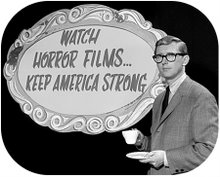
What follows is layer upon layer of secret intrigue, zombie mayhem, evil plans, and voodoo rituals, and James and Bill finally realizing Jeff was right about everything. Moreland really gets to cut loose comedically in the scenes where Jeff is hypnotized into believing he's a zombie, delivering my two favorite lines in the movie. First, after repeating the phrase "I am a zombie," he zombie-walks over to a line of fellow zoms and says, "Move over, boys. I'm one of the gang now." Second, after much conversation with Samantha about his new zombie lifestyle, she tells him that he can't be a zombie because zombies can't talk. He responds, "Can I help it if I'm loquacious?" To my great delight, I was familiar with some of these scenes from watching them on my prized VHS copy of Horrible Horror. I got it for Christmas when I was 10 or 11, and I've watched it roughly 37,000 times in the years since. It's a compilation of scenes from b-movie horror and sci-fi from the '30, '40s, '50s, and '60s, hosted by the late, great John Zacherle aka Zacherley the Cool Ghoul, a rock DJ and, for years, horror host of late-night creature feature shows Shock Theater in Philadelphia and Chiller Theatre in New York City. "Can I help it if I'm loquacious?" pops into my head about once a week since the late 1980s thanks to this videotape.

Back to the movie. King of the Zombies is pretty damn entertaining, despite the racist moments and despite Jean Yarbrough's pedestrian visual style (see my review of Yarbrough's The Devil Bat a few months ago). The black cast members really pull this one up and give it the life and energy the milquetoast white characters are lacking, though Victor makes a pretty good villain. In some ways, I'm glad he got the part instead of Lugosi or Lorre because he's less immediately readable as a classic baddie. You're left wondering what the hell he's up to for quite a while.

Before I bid you adieu, I have to say a few words about Mantan Moreland. Moreland was a showbiz lifer, working in vaudeville from his teen years, performing live comedy, and acting in dozens of movies until his film career hit a snag in the 1950s. An understandable backlash to the kinds of roles black actors were forced to take in the first half-century of film and how those roles contributed to the perpetuation of racist stereotypes unfortunately led to many of these same actors struggling to find roles in the '50s. Moreland turned to live performance in the '50s to make a living, though he came close to being a Three Stooge after the death of Shemp Howard. Moreland was Moe Howard's choice to replace Shemp, but the Columbia execs told the surviving Stooges they needed to use someone who was already under contract with the studio, so Joe Besser got the gig. Though he popped up in bit parts and cameo roles in the '60s and early '70s in movies including Carl Reiner's Enter Laughing and The Comic, Jack Hill's Spider Baby, and Melvin Van Peebles' Watermelon Man, Moreland's main focus for the remainder of his career was live comedy performance and comedy records, often as part of a duo with Roosevelt Livingood. It's on one of these 1960s Moreland and Livingood comedy records, That Ain't My Finger, that Moreland utters the immortal line, "Shit, if this is gonna be that kind of party, I'm gonna stick my dick in the mashed potatoes," famously sampled by the Beastie Boys on their 1994 song "B-Boys Makin' with the Freak-Freak" to the delight of 1990s teens worldwide.



No comments:
Post a Comment