Saturday, May 31, 2025

Deathstalker and the Warriors from Hell (Alfonso Corona, 1988)

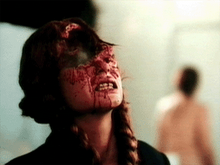
It's time for our third hit off that Deathstalker supply, which, unlike THC, will still be legal in Texas come September (though maybe not legal in school libraries). (Yeah, I'm writing this post at work.) This third Deathstalker movie also features a third actor playing the title role (though original Deathstalker Rick Hill would return to the fold for the fourth straight-to-video installment in 1991) but otherwise sticks to the sword and sorcery formula of the first film, dialing the second film's intentional humor way down. Up against the stylish, goofy, and pizzazz-filled action of the first two Deathstalkers, Warriors from Hell is a bit of a letdown, but it has its moments.
Opening with what can only be described as $2 Renaissance Faire, our new Deathstalker (John Allen Nelson, less of a beefcake than his two predecessors but retaining John Terlesky's frat boy look) is hanging out with some villagers in a field, sparring with a buddy on ye olde balance beame while his elderly wizard friend Nicias (Aaron Hernan) tells fortunes for some coinage. A hooded figure arrives and asks Nicias for a private convo in his tent. This figure is a princess, Carissa (Carla Herd). Carissa is yet another  princess whose family castle and throne have been usurped by an evil sorcerer, in this case Troxartas (Thom Christopher), but Carissa has a plan. She's got a chunk of magic stone, and she needs to find the other chunk. When she puts the magic stone pieces together, kablammo! Evil is vanquished and a lost city appears. She's been given some erroneous information that Nicias has the other piece, but Nicias regrets to inform her that Troxartas has it.
When people start talking about magic stones, my general response is, "who gives a shit?," but if these magic stones lead to good times, I'll allow it. While this magic stone tent meeting is happening, Troxartas' men ride up on horseback with their special masked helmets that look like bat wings ("da-na-na-na-na-na-na-na, bat mask") and start kicking villager ass. Nicias tells Deathstalker to save Carissa, and he'll distract the baddies with some wizard magic, which involves spinning around at incredible speed for a minute and then disappearing in a puff of smoke, leaving his footwear behind for some reason. The rest of his clothes are magically allowed to remain with the body.
Deathstalker and Carissa get away and camp out in the woods. Despite Deathstalker's offer to share the blankets, Carissa decides to spend the night in her own tent. Fatal mistake. Troxartas' bat boys catch up to them and fatally wound Carissa. Before she dies, she gives him the magic stone piece. Deathstalker is now determined to avenge Carissa and smush them damn stones together at Troxartas' place.
Deathstalker escapes the horde yet again and hits the road, sans horse. Passing a hillside cottage and barn, he attempts to "borrow" one of the horses on the property but is thwarted by the two women who live there, a potato-loving semi-crone with wild frizzy hair and her sexy daughter Marinda (Claudia Inchaurregui), and their bow and arrow skills. When Marinda pats Deathstalker down for weapons, she becomes mesmerized by Deathstalker's crotch. She gazes into it intensely for an extended period of time, like she's trying to find Waldo. Sensing the mood changing, Deathstalker gives a sanitized spiel of recent events, flashes the magic stone, and tells them he'll be back with hundreds of these stones if he can borrow a horse.
The women invite him to spend the night, but Mom, disapproving of the way her daughter has been checking out the goods, tells him he'll have to sleep in the barn. They have a potato meal with extra potato, and Deathstalker politely tells the ladies he'll catch them a rabbit for breakfast. This makes the older woman furious: "Rabbit? In this house, we eat potatoes!" Ah, I can't stay mad at this delightful lunatic.
Marinda, tired of being a sexy adult woman stuck sleeping in a bed with her insane mother and eating potatoes for every meal, sneaks into the barn for some erotic good times and great oldies with Deathstalker. Troxartas' bat dicks show up yet again, and Marinda's mother, noticing her daughter is not in the bed and putting two and two together, leads them to the barn. Too late. Marinda helps Deathstalker escape, and they plan to meet up later for more sexy times after the magic stone quest is done.
On the road to Troxartas (a fun name to hear and to say), Deathstalker gets tangled up with yet another princess, the spoiled and sassy Elizena, who happens to be Carissa's sister. She's also played by Carla Herd. More on that freak later. Elizena is also on her way to Troxartas because their marriage has been arranged. Carissa was hipper to Troxartas' evil ways, but Elizena is a shallow and materialistic woman who just wants to live in a castle and have power again. She's unaware that Troxartas just wants her for the magic stone. He's no fan of the ladies.
About that. Troxartas' servant/assistant is an attractive woman named Camisarde (Terri Treas). She's hot for Troxartas and repeatedly tries and fails to bust a move with the sorcerer. He tells her that the feeling is mutual, but he's far too busy trying to get the other half of the stone, increase his magic powers, and raise an army of warriors from the dead to do the wild thing. Camisarde is not picking up the signals that Troxartas is laying down, not even when he camps it up in the basement crypt in celebration after he successfully reanimates the dead warriors. (One of these reanimated warriors has the funniest and best line deliveries in the whole movie and steals every scene he's in. The guy rules. I wish I knew his character's name to give him full credit.) Don't feel bad, Camisarde. Elizena is equally clueless even when Troxartas pulls up on horseback in the countryside to escort her to the castle dressed like Little Edie from Grey Gardens with a hint of Freddie Mercury. You're never getting laid, Camisarde.
Eventually, everyone's at the castle and we get wizards, sorcery, battles, pratfalls, magic stone shenanigans, and swordfights, including one of the most bizarre and baffling swordfights I've ever seen between Deathstalker and Troxartas that looks like a cross between a poorly choreographed erotic modern dance performance and a Laurel and Hardy routine.
You'll notice I haven't been saying much about the filmmaking. This third installment in the franchise looks more like television than cinema and is the least visually appealing of the three. I'm not saying the first two Deathstalker movies are wonderlands of visual invention, but they do have some of the ol' razzle-dazzle. The visual style of this movie is basically just to film the script without putting any fucking fairy dust over the bastard, to paraphrase the Troggs tapes. It's a mildly entertaining movie, but it's not as much nonstop fun as the first two.
I said I'd get back to Carla Herd, the woman who played both princesses. Her acting career was short, lasting from the late 1980s to the early 1990s. She appeared in one other film, the low-budget action movie Wild Zone, and had a one-year recurring role on the soap opera The Bold and the Beautiful. Her other credits include episodes of Houston Knights, 1st & Ten, and Monsters. Unless you're a b-movie aficionado, you probably know Carla Herd by her married name, Carla Sands. She married real estate and investment company CEO Fred Sands and took over as CEO after his death. She's also a hardcore MAGA nut whose massive campaign contributions to Trump led to her becoming one of his economic advisors and eventually ambassador to Denmark in Trump's first term. She also unsuccessfully ran for Senate in her home state of Pennsylvania, coming in fourth in the Republican primary that Dr. Oz won. She falsely claimed her vote wasn't counted and that she was disenfranchised, which was disproved by the New York Times. Her ambassadorship included numerous Hatch Act violations, but because we live in MAGA world, nothing happened. She likes to tweet and say stupid shit, including that Danes can't afford cars and have to bike everywhere, a nightmare she claimed Biden would bring to this country ("the horror, the horror"), and that the U.S. should aggressively take Greenland from Denmark. Needless to say, I'm glad Deathstalker didn't end up with Elizena at the end of this thing.

Saturday, May 17, 2025

Death Wish 4: The Crackdown (J. Lee Thompson, 1987)

We're back again with the continuing saga of the world's unluckiest man, architect turned vigilante Paul Kersey (Charles Bronson). After his return to New York in Death Wish 3 culminated in him wiping out the head of another gang of multicultural street punks (along with the wall of an apartment building) with a missile launcher (fired from inside the apartment!), he's somehow free from imprisonment and back in Los Angeles working as an architect. In the two years since his Brooklyn gang war throwdown, he's settled down with a new girlfriend, investigative journalist Karen Sheldon (Kay Lenz), and her teenage daughter Erica (National Lampoon's Vacation's Dana Barron), who wants to be an architect and has submitted some sketches and drawings to Paul's firm that meet with Paul's approval. This kid is going places. Unfortunately, since Paul Kersey is in her life, those places are the morgue.
Erica is a sweet kid, but she and her boyfriend have been experimenting with drugs, to Kersey's quiet disapproval. The guy's murdered at least 80 people by this point, but he's no fan of puffin' tuff. Sadly, Erica's not just hitting that sticky icky. The sinsemilla is a gateway to the white stuff. The powder. C-c-c-c-c-cocaine! After they hit up their dealers for some weed at a quintessential '80s arcade the pushers use as a base of operations, one of the dealers gives Erica a free bag of coke, just as the '80s authority figures prophesized in their Just Say No propaganda. Dealers giving away expensive drugs, shake my damn head. Because the accidental angel of death Paul Kersey is a father figure to Erica, she dies of an overdose upon her first taste of the coke.
Kersey follows Erica's boyfriend back to the arcade after the funeral and watches him confront one of the dealers. They take the argument to the parking lot near the bumper cars, where the young man stupidly and repeatedly announces his plans to go to the cops. The dealer knifes the kid, but Kersey takes out the trash Death Wish-style. A hilarious punk rocker with a distinctive Valley accent played by Mark Pellegrino (who had small but memorable roles in The Big Lebowski and Mulholland Drive) gives his eyewitness account to Detectives Reiner (Blue Velvet's George Dickerson) and Nozaki (Soon-Tek Oh). (When pressed to come up with the full license plate number after he's only able to remember the last three digits: "Hey, I ain't a fuckin' detective. You are.") Our detectives think his description sounds an awful lot like suspected '70s and early '80s vigilante Paul Kersey. Somehow, no one has heard about the multi-block full-scale Brooklyn gang war of two years earlier, even though roughly 18 gangs and a missile launcher were involved and several buildings exploded, but this is LA, baby. Let New York handle New York.
After the bumper car blasteroo, Kersey gets a blackmail-threatening phone call from a mysterious wealthy stranger, newspaper magnate Nathan White (cult movie legend John P. Ryan), who knows all about his vigilante past. A limo is already waiting to take Kersey to White's mansion. White says his daughter died of a cocaine overdose, and he's ready to destroy the Los Angeles drug trade in revenge. He'll pay Kersey to use his murderin' skills to take out the two major drug suppliers in the city, Ed Zacharias (Perry Lopez) and the Morello family and as many of their henchmen as is necessary. (One of Zacharias' henchmen is a pre-fame Danny Trejo.) 
White has a dossier on Zacharias, the Morellos, and all their employees and gives Kersey some colorful descriptions. My favorite is his assessment of Frank Bauggs (David Fonteno), one of the Morellos' top guys: "He's a trained baritone and an upwardly mobile super-achiever."  If you're thinking Nathan White and his bizarrely indeterminate accent, eyebrows, and wig have ulterior motives and maybe aren't what they seem, then you may be a sentient being, which is more than we can say for half the American voters.
Kersey takes two days to think it over, decides against it, and the movie ends. Just kidding. He of course says yes and starts blasting away as well as pitching the crime organizations against each other, Yojimbo-style. While all this is happening, Karen decides to turn her grief at losing her daughter into a series of articles about the local drug trade and its human cost for the newspaper she writes for, at which point the movie completely forgets about her until the concluding scenes.
What follows is a series of exciting, hilarious, stupid, and, dare I say, underrated Death Wish moments taking place in such cinematically satisfying locations as the aforementioned video game arcade, bumper car ride, luxury condo, drug dealer mansion poolside birthday party, spooky parking garage, oilfield, fish processing factory/drug front (with guards Mitch Pileggi and "Judo" Gene LeBell), video store (with standees of Leatherface and Harrison Ford promoting new releases The Texas Chainsaw Massacre 2 and Witness) and an absolutely hoppin' roller rink, and weapons including an array of guns, an exploding wine bottle (hilariously, two of the characters' dummies are left onscreen a few seconds too long before the explosion), a damn grenade launcher, and the classic but deadly hands and feet of Chuck Bronson.
Yes, some of this feels more like the usual lone badass vs. organized crime '80s action movie landscape than a Death Wish movie, but all of it is pretty damn enjoyable. This fourth film has less of a cult following than its predecessors (especially the bonkers third installment), but it honestly may be tied with the third one as my favorite. (Almost everyone agrees that the fifth and final film in the franchise sucks, including Bronson.) It's less of a right-wing fantasy than the others, with the "drug pushers are killing our kids" moral panic mostly just a pretext for a bunch of kickass action sequences, and it dispenses with the rape obsessions of the Michael Winner-directed first three. There is an attempted rape scene at the very beginning, but it's part of a dream sequence that parodies the first three films and lets us know this one is going to be a little different.
Winner and Bronson were on the outs at this point, and veteran Hollywood filmmaker J. Lee Thompson took over. Thompson directed his first film in 1950 and was a few years away from retirement when he made Death Wish 4, though he worked at a prolific pace all the way through the '80s (mostly with Bronson) and may have directed more movies '80s American kids watched with their dads, uncles, or classmates than any other filmmaker on earth. Any time groups of dudes were sitting around a TV watching a movie between 1982 and 1992 in the United States, there was a one in twelve chance they were watching a Thompson movie (I made up this statistic but I stand by it.)
Thompson is a better technical filmmaker than the rough and ready Michael Winner, which has its pros and cons. His Death Wish movie has a smoother construction, more graceful camera movements (weren't expecting the word "graceful" in a Death Wish review, were ya?), and some impressive shot compositions. It's the best-looking movie in the franchise. Winner is better at the raw stuff and the gritty grindhouse scuzz, which is missed here ("hey man, where's my scuzz?"), but he compensates by creating some truly nutso action sequences and packing every frame of this thing with character actors, weird-looking dudes, and weird-looking character actors. I also love that a bumper sticker on a drug dealer's van reads "I ❤️ New Wave." Modern filmmakers tend to leave out these absurd little details that give a movie so much life.
Thompson made a lot of modest theatrical hits and cult films, but his movies did their best business on home video and syndicated local television networks. My favorite Thompson movie is the original Cape Fear, with Gregory Peck and Robert Mitchum, memorably remade by Martin Scorsese in the 1990s. Other notable pre-1980s peak Dude Cinema Thompson films include The Guns of Navarone, Mackenna's Gold, Conquest of the Planet of the Apes, Battle for the Planet of the Apes, the 1974 adaptation of Huckleberry Finn, and The White Buffalo, but most of his '80s movies were in even higher rotation on the televisions of my youth. His non-Bronson films that decade were the cult slasher movie Happy Birthday to Me; The Ambassador, a loose adaptation of Elmore Leonard's 52 Pick-up with Mitchum; the adventure movie King Solomon's Mines, with Richard Chamberlain and Sharon Stone, that was on WTBS and KWGN almost as often as The Beastmaster; and Firewalker, with Chuck Norris and Louis Gossett Jr.
Thompson made seven movies with Bronson in the '80s in addition to the four non-Bronsons. Besides Death Wish 4, the collaborations included Cabo Blanco (Bronson looking for Nazi gold in Peru), 10 to Midnight (Bronson versus a serial killer of young women), The Evil that Men Do (Bronson versus a foreign dictator's go-to torture guy), Murphy's Law (Bronson versus the real killer who framed him for the murder of his ex-wife), Messenger of Death (Bronson versus a killer targeting Mormons in rural Colorado), and Kinjite: Forbidden Subjects (Bronson versus sex traffickers of underage girls). Somehow, Thompson also found the time to direct an episode of Code Red and write the screenplay for sci-fi b-movie Future Hunters that decade. No wonder the guy retired after wrapping up Kinjite.