Saturday, September 12, 2015

#215: Warning Shadows (Arthur Robison, 1923)

Warning Shadows, a fascinating German Expressionist oddity, is a silent film in the purest sense of the term. There are no intertitles, leaving the film to its own entirely visual devices to tell the story. The film uses shadow more than any other I've ever seen (it's right there in the title), and the plot depends on characters looking at the shapes made by shadows on the wall, through curtains, and projected on a hanging sheet. The film is pretty self-referential for 1923, with the act of watching movies and voyeurism in general its true subjects aside from the moralistic message-making discouraging married women from flirting with single gentlemen.
The story begins with a wealthy baron (Fritz Kortner) and his lovely wife (Ruth Weyher) giving a fancy dinner for four gentlemen. (None of the characters' names are revealed in the film.) Unfortunately for the baron, these men have the hots for his lady, and she loves the attention. She's particularly into the overtures made by the youngest, handsomest gentlemen (the awesomely named Gustav von Wangenheim) and makes it quietly but perfectly clear she's willing to reciprocate his affections. Our baron is a tightly strung dude at his best, and when he sees the shadows of three of the gentlemen caressing his wife all over through a curtain, he understandably loses it. Unfortunately for the baron, this shadowplay is a proto-sitcom hilarious misunderstanding. The non-von Wangenheims are an immature, horny, prankster bunch, and they notice if they stand behind the woman and make lewd gestures by the curtain, their shadows look like they are groping her. The baron saw some bawdy pranks, not the actual touching of his lady love.
Compounding the drama, the servant holding the candles (Eugen Rex) can't stop smiling at the shadow pranks and is slapped by the baron's wife for his lack of composure. Understandably pissed, he allows the baron to continue thinking his house guests have been taking liberties. It's not the trio of lewd goofballs the baron should be worried about, though. Handsome young von Wangenheim is making eyes at his wife, and they keep brushing up against each other and almost holding hands. The baron starts stomping around his castle like a madman and sees a creepy-looking shadowplayer (Alexander Granach) putting on a shadow show on the wall for the servants. He gets an idea and convinces the shadowplayer to put on a cautionary tale for his guests and wife, showing them the terrible consequences of their flirtatious behavior. The shadowplay seems to exert a spell over the castle, and events in the story are brought to life. Things get dark.
Though Warning Shadows is more novelty than masterpiece, it's filled with beautiful shots that must have taken a tremendous amount of work to set up, particularly a moment when the shadowplayer elongates the shadows of the dinner guests. I'm a sucker for screen-within-a-screen shots, and Warning Shadows is full of them, most strikingly in the shots of the backs of the dinner guests heads as they watch the shadowplay on the movie screen-like hanging sheet. It's interesting that this early in the medium, a filmmaker is already depicting what it looks like to watch a movie on the big screen. The romance, mythology, and seduction of shadows and light projected on a white screen in a darkened room. That's the real subject of this film.
Director Arthur Robison has an interesting history. The son of German Jews who had moved to the United States, Robison was born in Chicago but moved with his family back to Germany when he was a child. Educated and raised in Germany, he attended medical school at the University of Munich. He worked as a doctor for several years before falling in love with film, and he made his first feature in 1916. Warning Shadows was his third surviving feature. He made 17 more before his death in 1935 at the age of 52.  

Saturday, August 29, 2015

#214: Backwoods aka Geek (Dean Crow, 1987)

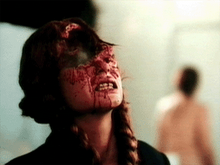
This low-budget straight-to-video micro-indie shot in rural Indiana explores one of my least favorite subgenres of horror -- city slickers terrorized by backwoods hillbilly psychos -- but it manages to develop the characters beyond most films of this type and give them unexpected traits. It avoids some of the duller and more irritating cliches, and though it's hardly a wonder of visual expressiveness, it doesn't look sloppy or inept. I may be damning Backwoods with faint praise, and I wasn't a huge fan, but it's a decent little horror movie.
Backwoods begins with our leads, couple Karen and Jamie (Christine Noonan and Brad Armacost), in the midst of a cycling/camping vacation. They're biking back to their home city of Detroit and decide to take a break and camp for the night in small-town Indiana. Karen and Jamie are an intelligent, resourceful pair, but they're also a couple of smartasses, as we discover when they tell the park ranger (Gary Lott) that they're brother and sister when they're clearly a couple and as we keep discovering when they encounter the family in the woods. Writer/director Dean Crow seems to be going for some of the smartass chemistry Albert Brooks and Cybill Shepherd shared in Taxi Driver (minus the unrequited sexual tension on Albert's part) and Armacost appears to be doing a Brooks impression. (By the way, Armacost is the only one in this cast of nonprofessionals who had an acting career after this movie. He primarily works in theater, but he's appeared in small parts in several movies and TV shows.)
The park ranger gives them some camping options but warns them away from a particular stretch of the woods, saying that a group of Indianans tried to settle there in the 1920s but died out and that locals steer clear of the place. That sounds like the perfect spot for Karen, and they pitch the tent there despite Jamie's reluctance. The next morning, they hear a gunshot right by their tent and find a man standing over the body of a young girl. She's been accidentally shot. Fortunately, Jamie's a doctor. He's able to help the girl, Beth (Leslie Denise), and her imposing but grateful hillbilly father, Eben (Dick Kreusser), tells them to come with him. They can camp on his land, and he will feed them in return for their medical assistance.
In spite of genre stereotypes, Eben and Beth are not crazy inbred psychos, though Eben is pretty eccentric and can be intimidating when he's drunk on moonshine. He's basically a goodhearted man with some quirks. Unfortunately for everyone, Eben has another kid, a grown man with the mind of a feral, animalistic murderous lunatic who lives in the abandoned smokehouse and bites the heads off chickens. His name is William (Jack O'Hara). He spies on Karen skinny dipping in a nearby lake and gets fixated on her, to the downfall of almost everyone. I was worried when this scene started, but fortunately this movie avoids rape scenes. Rape horror is my least favorite subgenre by a huge margin, and it too often goes hand-in-hand with the crazed hillbilly movie. Christine Noonan's character is capable and resourceful, but she still has to get naked in several gratuitous nude scenes, probably a prerequisite for 1980s video distribution money, but I'm grateful rape scenes weren't a part of it.
You can probably guess the rest of the story, but Crow generates genuine suspense, and O'Hara is a frightening presence. The performances are rough, as is to be expected from a movie where everyone is making their first and in many cases only film appearance, but the lack of polish has an authentic charm I value. I can't say I genuinely enjoy this type of film, but this one is a lot better than it has any reason to be, and Crow knows how to make his tiny budget work. This one is hard to track down now, but as of this date, someone has put it on YouTube.