Saturday, October 29, 2011

#119: Communion (Philippe Mora, 1989)


I'm a skeptic, but I'm also open to the possibility I could be wrong and this world could be much stranger than we know. I even had my own bizarre encounter with something I can't entirely explain when I was a senior in high school. I wasn't anally probed or abducted by small gray men or the skinny ones with the oval heads and the large eyes or anything like that. I didn't see any beings, and I didn't have any weird stuff done to me. I did see something, though, that I can't quite find a place for in the world of hard facts. I was driving down the highway at night on a Friday in my parents' brown station wagon, which my friends and I dubbed the "Meat Wagon of Doom." I was a few months away from graduating high school, and I was feeling isolated, alone, and melancholy. I grew up in a rural small town in western Nebraska, and I didn't fit in at all. I was feeling that sting of isolation after a particularly alienating week, so I decided a long drive by myself was the perfect complement to my dark mood. I started driving south of town with no particular destination in mind. I planned on driving for ten or fifteen miles, then turning around and heading back to town. When I got about seven miles out of town, a large, strange aircraft flew over my car and hovered there for a few minutes. I remember thinking it was an airplane, but when I looked up at it, I noticed it was much closer to my car than an airplane should or would have been. Its shape resembled a smaller version of the ship from Close Encounters and it was covered in lights, some of which pointed down at me. I remember feeling thoroughly creeped out. I kept driving and the ship eventually moved upwards and out of sight. I turned the car around and drove back home.

What happened? I still don't know, but most of me believes it was a military aircraft. Several closely guarded military institutions exist in the countryside near my hometown, thanks to its low population. Some of our nuclear weapons are housed there, and it's probably a great place to test experimental aircraft. I don't think I was buzzed by an alien ship, but a tiny part of me would like to believe I was. The weird thing about this encounter was how quickly I forgot all about it. A week later, and I was once again preoccupied with teen angst. I didn't remember my mothership sighting until the end of my college years, five years later. Why did I forget about it so suddenly and for so long? That's the part that creeps me out the most. What if I imagined the whole thing? Memory is unreliable, deceptive, and strange.

Philippe Mora's 1989 alien abduction movie, Communion, covers this uneasy feeling well. Is this really happening? If it is real, why is it happening? Based on Whitley Strieber's 1987 nonfiction ("nonfiction"?) account of his own encounters with beings from somewhere else, Communion features a great, gonzo Christopher Walken performance, some wonderfully creepy scenes, some hilariously ridiculous scenes, a frighteningly accurate portrayal of depression, and dancing aliens. Strieber's screenplay for the film admirably refuses to answer questions, presenting the possibilities that the "visitors" are aliens from another planet, beings from another dimension, religious visions, or psychotic hallucinations. My own skepticism puts me in the last camp. I think Strieber believes these beings visited him, but I don't believe these beings exist.

Whitley Strieber was a horror novelist whose first two novels were made into the films Wolfen and The Hunger. In the late 1980s, he announced that he'd been visited by possibly alien beings beginning in 1985, and he documented this supposedly true experience in 1987's bestselling Communion. He's since followed up with several sequels. In my opinion, his credibility has been damaged by his affiliation with Art Bell and penchant for believing in bizarre conspiracy theories about sudden climate change and some hokum about "the Master of the Key," information he claims to have gleaned from a mysterious elderly man who visited his hotel room one evening. (The disaster blockbuster The Day After Tomorrow was based on one of his novels.)
I read Communion when I was in fifth grade, but I remember very little about it except that I expected much more terrifying descriptions of alien probing and experimenting than I received. The book was a bit dull for a 10-year-old who wanted action and thrills. Director Philippe Mora (The Beast Within, Howling II, Howling III, Mad Dog Morgan) and star Christopher Walken fortunately provide the action and thrills I wanted when I was a child.

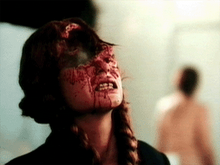
The movie breaks down into roughly six sections, each with its own tone and feel. It begins with Walken delivering one of his hilarious, offbeat, amped-up-to-10 performances. Walken, like Nicolas Cage, is one of those rare actors who is at his best when he chews the scenery. The beginning scenes establish a warm, comedic rapport between Strieber (Walken), his wife Anne (Lindsay Crouse, David Mamet's ex-wife), and his son Andrew (Joel Carlson) in their New York City apartment. Walken plays Strieber as an eccentric goofball, with the odd Walken pauses, outbursts, and dances. The second part takes place in the family's rural upstate cabin and is the most unsettling. It is here where the alien visitation begins, and Mora does a great job of creating a feeling of creeping dread and unease. Though the film was obviously made on a limited budget, Mora does great things with lighting and editing. These are scary scenes. We also get some anal probing and needles into the back of the head. The third part of the film concerns Strieber's difficulty understanding what's happening to him as he descends into depression and anger. This domestic drama portion of the film is also highly effective. As someone who's suffered from depression off and on for the past two years, I watched these scenes with both difficulty and admiration because they were so accurate. The fourth part of the film is less effective as Strieber seeks out psychiatric help, undergoes hypnosis, and takes part in a group therapy session with other people who have seen the beings. The film loses momentum here and drags a bit, seemingly unsure of which direction to take the material. The fifth part gets into hypnosis-inspired memories, hallucinations, dream sequences, and more interactions with the beings. Some of this stuff is laughably hilarious, but it's all super fun. Walken meets an androgynous magician version of himself, talks to the aliens, dances with them, gives them high-fives, parties with them while shirtless, and puts an alien face over his own face. I detect some strong Cronenberg and Lynch influences in these sections of the movie. The film ends with more diffuse, scattered scenes in which Walken and his wife theorize about why he is the recipient of this visitation. There is no real conclusion, but how could there be?

Communion is a strange film. Its melding of tones never quite coheres into anything solid, but that's precisely what the movie's about. Strieber doesn't know what is happening to him, why it's happening, or who these visitors are. Maybe he's nuts. Maybe he's a liar, perpetrating a hoax for the sake of book sales. Director Mora says he was approached by a man at a film festival who told him his movie was inaccurate. "How do you know?" Mora asked the man. "Because the aliens told me," the man replied. It's a weird world.

Saturday, October 15, 2011

#118: Charlie's Family aka The Manson Family (Jim Van Bebber, 2003)


NOTE: I'm not sure why Rue Morgue calls this movie Charlie's Family on its list. Charlie's Family was the film's working title as it was being shot, but The Manson Family is the theatrical and DVD release title and the one you should look for if you want to see it.

Jim Van Bebber is a persistent man. What began as a friend's idea for a quick exploitation movie turned into a heavily researched obsession that took years to complete. Van Bebber started shooting his Manson film in 1988 and finished the bulk of that shoot several months later. Years of financial problems followed before more shooting in 1996 and a rough cut that played a few festivals the following year. Van Bebber endured even more financial trouble before finally securing enough backing to complete the film, which was finally released in 2003.

Was all that trouble worth it? The story of Charles Manson, his followers, and the murders they committed has been told repeatedly. Manson has become a meaningless counterculture T-shirt image and a passing fad for several immature rock stars and surly teens, a sort of mass murdering cult version of t-shirt Che Guevara or dorm poster Einstein. Books, movies, TV movies, TV specials, talk show discussions, CD and vinyl releases, posters, magazine articles, t-shirts. The Manson market is saturated. In 1988, when Van Bebber started work on his film, Manson was experiencing a resurgence of interest in his weird life story thanks to a sensationalistic Geraldo special. In 2003? Was anybody clamoring for another addition to the Manson media pile? My own ambivalence to yet another retelling of the story kept me out of the theater when the film played my city.

After seeing Van Bebber's take on Manson's family last night, I have to admit that Van Bebber's exhaustive efforts to get his film released were worth it. Van Bebber tells a familiar story, but he tells it in such a structurally inventive way with such energy and low-budget indie resourcefulness I couldn't help but be won over. This is the kind of low-budget exploitation/art/horror/sex/gore/underground/psychotronic filmmaking that hasn't really existed since the Internet became a thing we all have. Van Bebber also wisely chooses to make Manson himself a peripheral character. Instead, he focuses on the family members who carried out the murders. There's really no explaining the appeal of Manson or any other cult guru. The people who choose to follow these guys and their reasons why are the interesting part of the story, a part that is too often marginalized. Why would someone follow David Koresh? That's always fascinated me more than Koresh himself. Also, this movie has more boobs than a Russ Meyer film, so there's that. (A boobstravaganza, you might say, if you're a dork like me.) Wangs, too, straight ladies and gay men.

Van Bebber has done a lot with very little money. He has an accomplished visual sense, with a sharp eye for shot composition and editing. He skillfully creates his narrative from an offbeat structure that juxtaposes recreations of the family on their compound in the desert and the murders they commit in the city with faux-documentary footage of interviews with the members in prison years later, conversations between news producers putting together a special about the murders, and a group of crazy, drugged-out punks planning their own murder spree in the present (well, the then-present of 1996). On top of this roiling stew of formal structure, Van Bebber adds stylistic flourishes adopted from non-narrative avant-garde and underground exploitation filmmakers. Van Bebber interestingly uses a variety of film stocks and video to give each section a distinctive look. The 1960s-set scenes look like a late-'60s/early '70s film with scratches and grain, the faux-documentary stuff resembles 1980s videotape, and the 1990s-shot footage looks like a low-budget '90s movie. Everything clicks and the various parts add up to a unified whole.

Van Bebber primarily used non-professional actors, and some of the performances are pretty rough. This roughness, rather than detracting from the film, adds to its handmade charm. I'd rather see an awkward amateur give it a good try than a talented Hollywood star sleepwalk through another big-budget mediocrity any day. Besides, several performances, including Van Bebber's own as Bobby Beausoleil, are strong. The film continually walks a fine line between exploitation and a genuine portrayal of the cowardly, horrible crimes these people committed. The violence is intense, bloody, and copious. No attempt is made to sugarcoat or glorify the behavior of the family.
Though the film was inspired by Geraldo's ridiculous late-1980s TV special about murder that featured his Manson interview (I taped it off the TV as a kid and watched the VHS over and over again), in which Geraldo comes off even worse than Manson does, one never gets a sense of who Manson is and how he exuded the charisma that enticed people to follow him as a fucked-up Christ figure. Some critics consider this a weakness. Maybe it is, but if Van Bebber chose to move in that direction, the film's focus would have shifted away from the others. Van Bebber instead gets the multiple, contradictory perspectives of the family members, the way they each downplay their own involvement and implicate others, their differing accounts of certain events, their various entry points into the cult. This varied perspective nicely matches the varied structure.

Part of the pleasure I took from The Manson Family was in recognizing an aesthetic that's largely disappeared thanks to the Internet's ahistorical, context-free potpourri of everything except the stuff you can hold in your meaty fists and the samey corporate look of most media. Van Bebber, a Midwesterner who gave The Manson Family a convincing Southern California look even though it was filmed in Ohio, has assembled a film that doesn't just tell the story of the Manson family. The film's lengthy production has accidentally produced a historical curiosity, a museum piece that documents the ways Midwestern kids like me sought out and soaked up the counterculture from the mid-1980s until the mid-1990s. This film stirred up so many memories for me. The 1970s blaxploitation, slasher, vigilante, and hippie films I caught on late-night TV when I was in elementary and middle school; the Hustler magazines my friend smuggled into school and showed us in the boys' bathrooms; magazines about skateboarding, punk rock, heavy metal, horror movies, and pro wrestling (Thrasher, Rip, Reflex, Fangoria, Gorezone, Pro Wrestling Illustrated) I'd buy at the grocery stores or look through in friends' basements (I remember one cheap wrestling magazine I often bought that had B&W newsprint that came off all over my hand and featured advertisements for videos of women's bikini oil wrestling in the back); cheap cassette dubs of friends' older brothers' thrash metal and hardcore punk tapes; fanzines; drive-in movies; USA Up All Night movies with Gilbert Gottfried and Rhonda Shear; straight-to-video exploitation VHS rentals from convenience stores; true-crime books from the library; catching Geraldo's Manson interview or G.G. Allin's appearances on Geraldo and Jerry Springer and Morton Downey on afternoon TV; word-of-mouth stories about movies, bands, and news events not readily available. None of this stuff happened alone in front of a computer. This was a mixture of the randomness of chance, genuine curiosity, and the small community of like-minded weirdos who thought, "There's something else out there besides football, blockbusters, and sitcoms. I need to see some weird shit and I need to see it now." This movie just exudes that sense of Midwestern isolation leading to cultural investigation, and how one went about finding it through trial, error, and accident in a huge but semi-hidden pile of exploitation, art, and trash in the last pre-Internet era.

P.S. One of the extras on the 2-DVD set is a documentary about the making of the film. Van Bebber is interviewed while chain-smoking cigarettes and chain-drinking Foster's. He sounds pretty drunk and spends a lot of the interview veering between down-to-earth descriptions about the practicalities of low-budget filmmaking and insanely hubristic pronouncements about his own talent and vision. He also brags a lot about drinking and smoking weed. He's a pretty hilarious guy.