Saturday, May 28, 2011

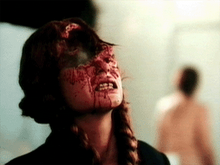
#108: Angst (Gerald Kargl, 1983)


Here's an interesting, neglected gem. Angst is an Austrian film about a serial killer that resembles few other serial killer movies. Most often compared to Henry: Portrait of a Serial Killer, Angst shares some similarity in tone with John McNaughton's classic but mostly exists in its own world. Never released on DVD or video in this country and many others, Angst can be downloaded from several cult film sites or tracked down on hard-to-find import DVD if you have an all-region player. It's worth the search.

I'm fascinated by directors who've made only one feature film, and Gerald Kargl fits the bill with Angst. A collaboration with Polish cinematographer/director Zbigniew Rybczynski, Angst was inspired by the story of mass murderer Werner Kniesek and contains quotes from several other murderers in the voice-over narration. Unlike many other serial killer movies, the protagonist here (Erwin Leder) is not a glorified, charismatic, evil genius. Instead, he's an insane, bungling, single-minded, almost stupid character whose crimes are poorly planned, messy, and chaotic. The film stays relentlessly on him, though it never tells us his name. We see the film almost entirely through his perspective, with the exception of two god's-eye-view shots at the beginning and end and a few quick shots of the victims.
The film opens with Leder in prison on the day of his release. Still a young man, he's already spent more than half his life locked up for the attempted murder of his mother and the random killing of an elderly woman. Released with no home and no plans for the future in a city he doesn't know, he wanders randomly to a strange cafe, where he eats a sausage dipped in mustard in extreme closeup and decides to begin another murder spree as soon as possible. He picks a female cab driver, but she becomes alarmed by his strange behavior and kicks him out of her cab on a deserted stretch of country road. He chokes and freezes, unable to go through with his poorly planned murder. He runs away, deep into the woods, and stumbles across a large, seemingly abandoned, sparsely furnished home. He decides to make it his base of operations, breaks a window, and crawls inside. Inside, he realizes the strange home is not abandoned and finds a mentally disabled, wheelchair-bound adult man. Soon, the man's elderly mother and adult sister return from the grocery store. Leder decides to torture and slowly murder the three, but his plans are thwarted by his own stupidity. I'll leave the rest for you to discover.

Though my description makes Angst sound like one of those dreary, depressing slogs with lots of torture and unpleasantness, the film is full of energy, offbeat but naturalistic humor, stellar performances, top-notch cinematography, and thoughtful shot compositions and camera movements. The score by ex-Tangerine Dream member and solo composer Klaus Schulze is also of high quality. This is a very good movie. I also need to mention that Angst contains the most entertaining wiener dog ever captured on film. Yes, you read that right.

This film contains some effectively stylized camera movements that aren't used to show off or wow the audience. Instead, they get you deeper into Leder's action, movement, and mental state. In some scenes, the camera is actually mounted to Leder's body as he runs or moves frantically. It's jarring, unsettling, and effective, and Kargl never overuses it. This placement of the camera has the odd visual effect of expressing simultaneous kinetic movement and an inability to move freely, a trapped claustrophobia. The film uses the camera to drive the story to its hilariously grim conclusion.

Another interesting aspect to this film that most other films with similar subject matter ignore is the messiness and work involved in murder. The cleanup, the moving of bodies, the repetitive brutality of making sure the person is truly dead, the blood, the broken glass and furniture, the inability to process the craziness of it. This guy isn't Hannibal Lecter. He's a nut, driven by impulse instead of intellect. He thinks he has some master plan, but his plan must continually change due to his own stupidity, the randomness of chance, the actions of his victims, and the intrusions of the world around him.

Kargl and Rybczynski aren't the guys you'd expect to make a darkly humorous yet brutal film about a serial killer. The two men wrote the film together, with Kargl directing and Rybczynski handling the cinematography. Rybczynski works steadily as a cinematographer and also directs short films and several Pet Shop Boys videos. Kargl never directed a feature film again, but he's worked steadily in film for most of his life. Prior to directing Angst, he created a successful film festival and published a movie magazine in Austria. Since Angst, he's worked as both a director of television commercials and an educational filmmaker for Austrian schools. On the strength of Angst, it's a real loss that he hasn't been able to make another feature. I strongly recommend this film.

Saturday, May 14, 2011

#107: Angel Heart (Alan Parker, 1987)


Alan Parker is one of those directors critics love to hate. He has a high opinion of his work and himself, but his films too often self-consciously masquerade as high art or hot-button issue movies, barely covering the ordinariness of the mildly fascistic middlebrow vulgarian more in line with Oliver Stone or Adrian Lyne than one of the greats. He's a bit of a dilettante as well, hitting different genres and countries without much personal connection to the material, though I'm certainly making an assumption I can't entirely prove. What I do clearly see in his films is much ugly stereotyping (every white male Southerner is a sweaty, racist, stupid, fat or emaciated hillbilly), use of women as sex objects or plot exposition (sometimes both), and a macho, right-wing interior covered by a thin liberal exterior. These qualities are shared by his one-time collaborator Oliver Stone (Stone wrote the screenplay for Parker's Midnight Express), but Parker is less ham-fisted and messianic than Stone.

I'll give Parker some credit. He's good with his lead actors, he picks talented cinematographers, and he can be pretty entertaining. His varied filmography appealed to precocious teenage boys and/or girls in the 1970s, 1980s, and 1990s. In that way, he can be seen as a gateway drug to better things, much like Jim Morrison, the Beat Generation, and mainstream alternative rock. Just look at this lineup: Bugsy Malone (1976), Midnight Express (1978), Fame (1980), Pink Floyd The Wall (1982), Birdy (1984), Mississippi Burning (1988), The Commitments (1991), and Evita (1996).

Angel Heart is my favorite Parker film, a period detective noir/horror hybrid that mostly succeeds despite Parker's flaws because of its intriguing premise, reliable genre thrills, offbeat cast, luscious cinematography, and visually stimulating locations. It's also my favorite Parker film for personal teenage reasons involving Lisa Bonet. I taped this movie off of cable television in my formative early adolescent years, and let's just say that some scenes on the video got more play than others. I hadn't seen this film in at least 12 or 13 years, but I knew every move Bonet was going to make. "She's going to bite her thumbnail here," I thought, and she did. It's some kind of voodoo post-pubescent muscle memory sexual attraction movie magic. Man, I can't believe I forgot how hot a 19-year-old Lisa Bonet was in this movie. Okay, I'll wipe my dirty old man drool off the computer and continue. Yeah, it was just two paragraphs ago that I criticized Parker for treating women like sex objects. Life is complicated.

Anyway, I like Angel Heart more than any other Parker film for many reasons, teenage lust being just one. I love the film's 1950s period recreations, exaggerated just enough without moving into self-parody. The location shooting in two of the most cinematically appealing cities on earth, New York City and New Orleans, doesn't hurt. The movie successfully blends two of my favorite genres, horror (freaking obviously) and film noir. I like the bananas cast. Mickey Rourke is the right guy to play a sleazy, charismatic private eye from Brooklyn, and Robert De Niro is just campy and amusing enough as the devil. (I'm not spoiling the end when I say that. His name is Louis Cyphre, after all, and he talks about eggs being a religious symbol for the soul as he devours a hard-boiled one.) I've already mentioned the Lisa Bonet factor, but I want to put in some positive words for her as an actress, too. I've heard people call her a bad actor, but I really disagree with that assessment. I like her understated, naturalistic style. There are also some fine smaller roles here for Charlotte Rampling as a fortune teller and legendary blues musician Brownie McGhee as a legendary blues musician. Who could see that coming? You will also see one of the worst acting performances ever committed to celluloid, from Elizabeth Whitcraft, which is thankfully brief.

The story begins with New York private eye Harry Angel (Mickey Rourke) called to the offices of Cyphre (Robert De Niro). A big band crooner by the name of Johnny Favorite owes Cyphre a debt, but Favorite is missing. Cyphre wants Angel to track him down. This seemingly straightforward job turns into a whirlwind, nightmarish journey through Harlem, Coney Island, New Orleans, the bayou country outside of the city, jazz, blues, voodoo, and Satanism, with plenty of murder, fistfights, dog bites, gumbo, partial nudity, blood, sex, chicken phobias, my favorite LaVern Baker song ("Soul on Fire"), and fat, racist Southern cops. The movie gets more ridiculous as it progresses, a visual motif involving a large fan is overused, and the twist ending is sub-Shyamalan, but it's all presented with such energy, fun, and sleaze that I didn't mind too much.
Angel Heart is not the masterpiece I believed it was when I was 14, but it's far less ponderous and more fun than Parker's other films. It has the good sense to locate the action in two of the four best noir locations, New York and New Orleans (the other two are Los Angeles and rural Texas, if you're keeping score), and the Satan and voodoo elements aren't overcooked until the movie's final moments. In the end, this is a fun 1980s genre hybrid that gives you the chance to see De Niro and Rourke act together and ogle Lisa Bonet. In these troubling times, that's saying a lot.