Well, I did it. I have watched, and in some cases re-watched, every film on Fangoria's "101 Best Horror Movies You've Never Seen" list. The initial plan for this blog was to complete that list and then pull the plug. I have two other blogs, and three seemed a little excessive. This would just be a long-term temporary project. I was a horror fanatic as a kid, and this blog proposed to get me back in touch with that childhood love before I put horror on the back burner again. Four years on from my first post, the plans have changed. I'm going to keep this site going indefinitely. I'm having fun writing the posts, my self-imposed schedule of one review every other week is low-pressure, I'm back in love with horror movies, and I have a dedicated audience that, though relatively small, is much larger than the audience for my other two blogs. So, thank you, my people, for reading and leaving nice comments and linking to me and spreading the word of mouth. In two weeks, I start my next crazy project. I will watch all of Rue Morgue magazine's "Connoisseur's Guide to 100 Alternative Horror Films." This list is even more varied and esoteric than Fangoria's list, and I look forward to tackling it.
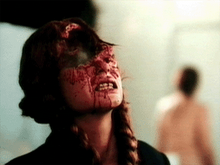
On to The Wisdom of Crocodiles. This late-1990s British vampire film from Hong Kong director Po-Chih Leong is currently available on DVD under the much more generic title, Immortality. Leong tries to do something different with the vampire genre and mostly succeeds, with the exception of a couple of howlingly stupid scenes I will discuss later. Instead of garlic, crosses, fangs, hypnotic eyes, and sunlight, this vampire has to approach his female victims the old-fashioned way, using only his charm, sparkling personality, and regular teeth. The twist this time is that the vampire can only feed on a woman who loves him. Once he kills and sucks the blood from a woman who loves him without reservation, he will be immortal. Until then, he goes through a succession of women who mostly love him, but harbor a certain amount of resentment, anger, suspicion, or uncertainty. These emotions manifest themselves in the blood and cause a painful reaction in the vampire that seems to combine acid reflux with the passing of a kidney stone. The vampire vomits forth a large crystalline shard and files it away in a locked wooden box above a piece of tape with the woman's name on it. He's satiated for a while, but he will need to find another victim if he wants to keep living.

The vampire (a pre-fame Jude Law) lives in a swank art deco apartment in a building that seems to house no other tenant. After picking up a victim that almost loved him (An Angel at My Table's Kerry Fox), he goes on the hunt again for that magic woman who can guarantee his immortality. He hits on a woman who intrigues him (Elina Lowensohn, who played a vampire of her own in Michael Almereyda's Nadja), and they begin a relationship. Meanwhile, his last victim's body unexpectedly turns up after an illegal fishing net scoops her up from Law's usually reliable dumping site. Law is not a suspect, but he purposely makes himself one after phoning the police and letting them know he used to date the woman and never reported her missing. Why does he do this? The movie never explicitly offers a reason, but I suspect his motivation is loneliness and boredom. The vampire lifestyle may be mysterious and glamorous in most other vampire movies, but this one is solitary, tragic, and isolating. Law strikes up a suspicious and adversarial mutual admiration society with the chief investigator on the homicide, played by Mike Leigh veteran and one of my favorite actors ever, Timothy Spall. (Spall has in fact had to get his ass replaced on at least 12 separate occasions after acting it off.)

Spall and Law's unlikely friendship begins during one of the film's two moronic scenes I mentioned earlier. Spall trails his prime suspect Law in the London Underground and is accosted by a gang of street thugs. This roving gang of toughs is a rainbow coalition of skullduggery. Almost two of every race, ethnic group, hairstyle, and fashion accessory are represented, with the possible exception of Eskimos and pageboys. Blacks, whites, Asians, Pennsylvania Dutch, 1990s techno DJs, greaseballs, grunge rockers, baldies, baseball caps. They're all here. It's a human Noah's Ark of street criminals. Regressive in all other aspects, this gang sure is forward-thinking when it comes to race relations. Besides the ridiculousness of the Benetton West Side Story gang's appearance, these guys are way too old and way too non-threatening in appearance to make the ominous impact Leong attempts. I kept expecting them to bust out some choreographed dance moves. The guys who accost Michael Jackson in the "Bad" video are scarier than these clowns. Law stops their beating of Spall with some wise words that any respectable multicultural street gang must respect. Unfortunately, these dorks show up in another scene. They have no business there, and appear only through a remarkable coincidence that is never explained, but you do get to see Law kick the shit out of them. Fortunately, the rest of the film works much better than these two scenes.

If you're looking for either a traditional vampire film with all the reliable mythology or a neck-biting bloodbath of gore, you're going to be disappointed by this film. If you're in the mood for a character-driven, low-key twist on the vampire genre, with cameo appearances from the world's stupidest street gang, you're in for a treat. Jude Law makes for a great vampire, Timothy Spall nicely underplays his detective and gives you a guy more human than cliche, and the production design is gorgeous. Leong has a nice eye, going for subtle composition rather than a bombardment of camera tricks. Instead of going back to the horror classics, Leong claims his visual inspirations for The Wisdom of Crocodiles were Kurosawa's Rashomon and Melville's Le Samourai. To be honest, I don't see much of Kurosawa in this film, but I caught plenty of nods to Melville's existential gangster film. Leong borrows that film's technique of slowly fading in and out of a single scene to indicate the passing of just a few seconds, or several hours. He also parallels Alain Delon's hitman in Melville's film with his vampire. Both men kill for a living, one for money, the other for immortality, both men are exhausted of living that life, both are lonely, and both are immaculately neat, solitary apartment dwellers. Leong doesn't have Melville's or Kurosawa's visual genius, but he does alright with his smaller palette.
The Wisdom of Crocodiles was Leong's first English-language film after a long string of Hong Kong genre films (mostly comedy, action, and mystery), and he currently works in American television. Maybe the street gang here meant to connect him with his comedy roots. Who knows? Barring those two silly scenes, I can recommend The Wisdom of Crocodiles to anyone looking for a subtler, more atmospheric take on the vampire myth.