Saturday, November 20, 2010

#96: The Unearthing aka Aswang (Wrye Martin & Barry Poltermann, 1994)


NOTE: This film is available on video and DVD under both its original title, Aswang, and The Unearthing. I had a much easier time finding it under Aswang.

This low-budget horror film made by two college buddies from Wisconsin for under $200,000 is well worth your time. Based on a Filipino vampire legend (coincidentally, I was drinking a Filipino dark lager while watching it), The Unearthing/Aswang shares some tonal, atmospheric, and visual similarities with early Cronenberg, the first two Evil Dead films, and the darkest childhood fairy tales. While it doesn't come close to early Raimi and Cronenberg at their best, it's pretty damn good in its own right and certainly better than the majority of mainstream films, including Gone with the Wind, Daddy Day Care, and Event Horizon. Aswang is low-budget without being cheap and amateurish, darkly funny without being campy, truly weird without being affected or "quirky," and honestly unsettling and scary.

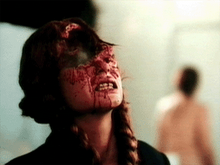
Aswang begins with a young woman discussing her unplanned pregnancy with her mildly mulleted metalhead boyfriend. Check out that alliteration. She has decided to sell the child to a couple who can't have a baby, with a slight catch. She will also be paid to pose as the wife of the couple at a rural Wisconsin mansion owned by the man's sickly mother so he can inherit the property. As he tells the young pregnant woman while they drive to the mansion, his mother won't leave him anything in the will if he doesn't produce an heir. Things get sinister when they arrive at the mansion, which looks like it was designed by Stanley Kubrick. The only inhabitants are the sickly mother, who keeps sucking on oxygen, a strange Filipino maid named Cupid, and an exotic white chicken who roams the premises freely. Oh yeah, there's also an unseen sister who lives in a cottage out back. Apparently, she's "a little touched." At this point, I'd probably call a cab and head back home, especially after seeing a painting of an aswang, a Filipino vampire who drinks the blood of newborns, given prominent place in the study. Fortunately, our heroine sticks around, ensuring our enjoyment of a fucked-up, unusual vampire movie.

First-time filmmakers Wrye Martin and Barry Poltermann wrote and directed Aswang together, and they did an admirable job of creating a lot with a little. Working with a cast of amateur non-actors, including Violent Femmes drummer Victor DeLorenzo as a bumbling sheriff, they get mostly naturalistic performances. Even the few awkward actors add to the film's weird texture. The directors have a nice eye (they share one giant eyeball), and though they're clearly new at the filmmaking game, they avoid a lot of dumb-ass overstylization and clumsiness. The film is loaded with atmosphere, too. A creeping sense of dread slowly increases, the house and the rural Wisconsin countryside are great horror movie locations, and the directors and their editors use sound and visual space well. The special effects are convincing, too, which isn't always the case in super-low-budget filmmaking.

I don't want to give too much away, so this review will be a little short. The movie's pleasures and surprises deserve fresh eyes and ears, and I don't want to diminish the Aswang experience. (That's what she said.) I'm a big fan of regional independent movies, and Aswang is a fine example of the creative freedoms possible within the financial limitations of non-Hollywood filmmaking. Joe Bob Briggs likes Aswang, too, so it's got that going for it.
Writer/directors Martin and Poltermann have remained active in independent filmmaking. Martin now works as a producer. Poltermann directed one other film, The Life of Reilly, a documentary about Charles Nelson Reilly's one-man show, and has enjoyed a long relationship with director Chris Smith as his go-to editor, working on American Movie, The Pool, and Collapse. I admire their later work, but I think these guys need to get back together and make another horror movie. Aswang is too good to be a one-off.

Saturday, October 30, 2010

#95: The Ugly (Scott Reynolds, 1997)


This disappointing debut feature from New Zealand writer/director Scott Reynolds presents a dilemma for me as a writer: I have a lot of specific things to say about the aspects of the film I disliked, but its virtues are a bit more amorphous and abstract. I will try not to beat up on Reynolds too much because he's attempting something interesting with the serial killer storyline, and I'll try to describe just what he's doing that works without getting too vague or fluffy. Let's begin by beating him up.
The Ugly takes place in a bizarre insane asylum in rural New Zealand housing prolific serial killer Simon Cartwright (Paolo Rotondo). Unlike most killers, he has no pattern for choosing his victims. He kills them by slicing their throats with a straight razor, but the weapon is the only constant. His victims are men and women, children and adults, friends and relatives and strangers. He doesn't rape, torture, or beat his victims, and he doesn't keep souvenirs. He's a mystery man. To use sophisticated psychological terminology, what is the cut of this guy's jib? Cartwright has been declared legally insane. Six years later, he decides he wants a second opinion, and requests famed and controversial psychologist Dr. Karen Schumaker (Rebecca Hobbs) for his reevaluation. This angers his current psychologist, Dr. Marlowe (Roy Ward), the head of the institution and a man who resembles a walking penis. He ensures that his only two employees, a couple of knuckle-walking goons (one of whom dresses exclusively in a sleeveless vest with no shirt underneath), regularly abuse Cartwright and attempt to intimidate Schumaker. He is what is known in the psychology biz as a dick. The rest of the film takes place in the two days in which Schumaker evaluates Cartwright, alternating between flashbacks to Cartwright's life before and during the murders, dream and fantasy sequences, and the present.

After a promising first fifteen minutes, the film unfortunately becomes a bit of a slog with some bright spots. Some of the blame can be placed on the miscast leads, Rotondo and Hobbs. I never accepted Rotondo as a serial killer. He lacks menace and intensity, and he's just physically wrong for the role. This may sound like a contradiction, but he's both too much and not enough of a pretty boy to convince as an indiscriminate killing machine. Maybe if the movie worked with Rotondo's almost-but-not-quite-teen-idol looks, something interesting would have developed, but painting him as a mysterious and threatening presence is a stretch. At least Rotondo is a fairly subtle actor. Hobbs chews scenery like she needs to compress every role she's ever had into one character. It doesn't help that the film's idea of psychotherapy is evil manipulation on the one hand (Marlowe) and yelling, confrontation, and high drama on the other (Schumaker). When Hobbs angrily throws all her papers on the floor with a sweeping gesture of her arms as she screams at Cartwright, I checked out. That is some ri-goddamn-diculous professional methodology. I think we're beyond the highly unorthodox at this point. "But she gets results!" you may offer in counterpoint. "Stupid results," I might reply.
Another problem with the movie is an overabundance of dream and fantasy sequences that borders on self-parody. On multiple occasions, the film devolves into the following sequence of events: Oh my god, that just happened! No, it was just a dream. Or was it? Yes, it was. No, it wasn't! Oh my god, yes it was! Or was it? No. Yes. Or, maybe... I sometimes wondered if I were watching a New Zealand version of an interminable Saturday Night Live skit.
Reynolds sometimes mistrusts his own admirable visual skill with abrupt switches to rapid jump cuts, shaky cams, and intrusive zooms in and out with an accompanying deep-focus/out-of-focus image. When he stays out of his own way and avoids over-stylization, he has a nice eye and the film is visually powerful. To his credit, he trusts himself more often than he feels the need to hyperbolically overzazz his imagery, music-video style, but when he punches up the visuals, the film becomes unnecessarily jarring and distracting.

My last criticism may be a little unfair since I'm slamming the film for what it isn't rather than what it is, but I found the overly serious tone oppressive. The Ugly tries too hard to be a serious art film but can't really pull it off. The movie's understanding of psychotherapy, serial killers, and mental asylums is too movie-cliched to reveal any new ways of seeing these subjects. A dose of exploitation or campy fun or a beheading or two would have been welcome, especially since the film's one moment of humor really worked. That moment involves penis-shaped Dr. Marlowe's secret one-way-glassed room with theater seats and piped-in classical music where he spies on Schumaker's sessions. Marlow is a balding, incredibly thin man with neatly trimmed sideburns and a soul-patch, and he's fond of wearing ascots. While he watches the session, he glares evilly and chomps on hard candy. The only thing missing is an aged cat or small dog for him to stroke while he formulates his evil plans.

Time to stop bashing Reynolds. Here's what he does right. His aforementioned visual skills are formidable when he's not bogged down in over-stylization. He has a nice eye for detail and shot composition, and the film's cinematography has that pleasing grit and grain often found in American films of the 1970s and Australian and New Zealand films of the 1970s-1990s. The black blood coming from the victims in the flashbacks and dreams is a nice little stylish touch that makes things seem not quite right without going overboard while also providing a payoff in the final scene. The asylum and Marlow's office are well designed, strong visual presences. The art director deserves some kudos for doing a lot with a little. The flashback sequences to the killer's childhood are handled in a straightforward, compelling way, ably performed by a strong cast. The mother gets some of the blame, as usual, but many actual serial killers had fucked-up mothers, so I can let this slide. Finally, the ghostly physical manifestations of the voices the killer hears are nicely handled. These apparitions are creepy and unsettling, and Reynolds uses them just enough without overusing them. I wish I liked this movie better, because Reynolds has some talent. Unfortunately, I can't work up much enthusiasm for The Ugly.