Many of my favorite films have something timeless about them. These artistic masterworks transcend their particular time and place and resonate as something essentially and permanently human. However, I also love films that belong to a specific time and place. Movies can show us how certain years and decades looked and felt, especially those films shot on location. We can see how people moved, talked, looked. What their hairstyles were, how they dressed, how they held their cigarettes, what they joked about, what they drank. We can see the cars, hear the music, see the landscapes and cityscapes and prevailing and countervailing attitudes of each year in history since 1895. Pioneering French film archivist, preservationist, and programmer Henri Langlois got at this when he said it was equally important to preserve every porno movie, not because of any cinematic importance, but because the indoor settings of most porn films provided an excellent filmed record of bourgeois furniture styles.

Night of the Comet, besides being a thoroughly entertaining horror/sci-fi/comedy hybrid, is an excellent record of the year of our lord 1984. I want to put forth the idea that 1984, pop-culturally speaking, was the most 1980s-esque year of the 1980s. Most of what we think about when we think about the 1980s happened in 1984. Look at some of the records that came out in 1984: Prince's Purple Rain, Madonna's Like a Virgin, Van Halen's 1984, Bruce Springsteen's Born in the U.S.A., Run-D.M.C.'s first album, Cyndi Lauper's She's So Unusual (technically released in late 1983, but the songs were all over the radio and MTV in 1984). In indie rock circles, a bunch of landmark albums came out in 1984 as well, including R.E.M.'s Reckoning, Husker Du's Zen Arcade, Minutemen's Double Nickels on the Dime and The Smiths' first album. Michael Jackson's Thriller, released in 1982, was still the best-selling album of the year in 1984. Look at the top 10 highest grossing movies of 1984, nearly each one era-defining (not always in terms of quality, though this list is much better than any from recent years):
1. Ghostbusters
2. Beverly Hills Cop
3. Indiana Jones and the Temple of Doom
4. Gremlins
5. The Karate Kid
6. Police Academy
7. Footloose
8. Romancing the Stone
9. Purple Rain
10. Star Trek III: The Search for Spock
A bit lower on the radar, but still culturally influential, and released in 1984: Repo Man, This Is Spinal Tap, the Talking Heads concert film Stop Making Sense, and Jarmusch's Stranger than Paradise.
On television, The Cosby Show and Miami Vice debuted, The A-Team started its second season, Family Ties started its third season, and Simon & Simon started its fourth season.

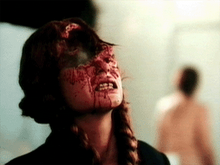
So, yes, as I was saying before I got into the minutiae of 1984 pop culture, Night of the Comet provides an excellent historical record of 1980s life. Set in that most 1980s of cities in that most 1980s of states, Los Angeles, California (particularly the Valley), the film begins on the night that a comet is about to pass extremely close to Earth. There are two factions when it comes to the comet -- those who believe the comet is a harbinger of the end of the world and those who want to put on their most 1980s of outfits and have a kick-ass Friday night comet party. (These scenes capitalize on two 1980s obsessions: Halley's Comet was two years away, and many of us thought nuclear war with the Soviet Union was imminent. Guess what else came out in 1984? Red Dawn.) Unfortunately, the apocalyptos were correct. The comet turns everyone outdoors into red dust, instantly. Those who were in some kind of shelter and indirectly exposed to the comet have it even worse. They are slowly turning into red dust, but before they do so, they spend several days as bloodthirsty, crazed zombies. There are a small group of lucky survivors. The comet's rays can't penetrate steel, so anyone who was enclosed in a steel building during showtime is gold. This includes two sisters, played by Catherine Mary Stewart and Kellie Maroney. Stewart, besides being a Asteroids whiz, works at a movie theater and spent the night in the projection booth, sleeping with the projectionist. The booth is made of steel, per fire code from the old days of exploding nitrate film, so her and the projectionist are good (at least, until he gets wasted by a zombie) and Maroney spent the night in a steel shed after getting into a fistfight with her stepmother and running away from home. The sisters reunite and realize they are seemingly the only two people left in Los Angeles, and possibly the world. They decamp to a local radio station that is still operating because the DJ patter is all canned. The station has plenty of purple neon lights because it is 1984 to the extreme.

Most reviews of the movie point out that our two survivors are Valley Girls. This is not accurate. They are from the Valley, but they don't speak in Valley Girl lingo. There is no mention of gagging with a spoon, gnarly, like for sure, or wow. They do like boys and shopping, but they are smart and adept with submachine guns and martial arts. They learned the art of weaponry and ass-kicking from their father, an ex-Green Beret who, at the time of the comet, is fighting the Sandinistas.
Night of the Comet maintains a high level of kick-ass entertainment throughout, as the girls fight off killer zombies, readjust to post-apocalyptic life, and meet up with other survivors. Things get even more complicated when an underground bunker in the desert full of scientists with conflicting motives enters the picture. One of these scientists is played by the great Mary Woronov, a one-time Warhol Factory scenester, who is in nearly every classic B-movie of the 1970s and 1980s. Fortunately, the movie also contains a looting-of-department-store musical montage set to a horrible cover version of Cyndi Lauper's "Girls Just Want To Have Fun." The rights to the original must have been too expensive.

Writer/director Eberhardt, who later directed Gross Anatomy and Captain Ron, has a knack for striking imagery here that I'm guessing he probably didn't take advantage of in Captain Ron. There is something haunting about human-made landscapes empty of humans, and the numerous scenes of abandoned suburban homes, buildings, cars, clothes, and swimming pools, with automatic sprinkler systems continuing to do their work, are eerily effective. The zombies look great, too, and since these particular zombies are still-living humans, they can talk, drive, and plot crazy schemes.
In short, this movie is awesome. 1984 4 Life!